
T h e R o l e - p l a y i n g G a m e (v 1.0a3)
Created by Corey Mosher & Michael Fiegel Written by Michael Fiegel Original concept by Corey Mosher
Additional content by Sylvia Gimenez, Dixie Li, Matt Linton & Kenshiro Aette
Iconoclast, the Iconoclast Role-Playing Game, and all related materials are
Trademark & Copyright 1996-2001 aethereal FORGE. All Rights Reserved.
[ RPG Text Version ] [ RPG Maps ]
Table of Contents
Introduction
Iconoclast began in March of 1996 as a hazy concept of a futuristic world that would incorporate everything that needed incorporating. In short, it was a reconstruction of everything, a world that represented the world, but for a few decades of difference. Genetic experimentation, cybernetics, neural interfaces, megacorporations, gangs and cults, millennial panic... topics the Cyberpunks had been writing about for years, now finally accepted as essential elements in all writing, and in all things.
Reality has finally caught up with science fiction. And reality is, as it turns out, scarier than the wildest Cyberpunk nightmares. In a way, the world of Iconoclast exists all around us, a frightening fantasy that is no longer just fantasy. So what happens when you take the present day and project it 100 years into the future?
That's where you come in.
Welcome to the dawn of the 22nd Century. Democracy has failed, having long since been replaced by a corporate mentality. Americorp and Eurocorp, on the verge of their second war over natural resources, are no longer the powers they once were. Globalization has led to a dispersal of resources and power. Money is the ultimate equalizer, and the ultimate goal; so much so that the value of the individual citizen has been all but erased.
There are no names now. There are only faces that pass each other by, like whispers on a foggy night. You are only what they have in their file, a value hastily scribbled in a column in a long-forgotten database, a mere calculation. You don't have feelings. You don't have any worth other than what you can do for them. You are not a person. You aren't even a character. You are an object. A thing. You are an icon.
Now, with no job, no money, and an uncertain future, you've picked up what little you have and headed to one of the few remaining bright spots on the planet: New Aurora, Oregon. Here, in this domed city of the future, there's shelter, food, money, a job, and hope... hope that you might one day be able to escape this hellhole your life has become, to achieve something greater than they could ever imagine. You will be an icon no longer.
You will become an Iconoclast.
[ /\ ]
1. Icon Generation
When it comes down to "Real, but difficult to play" or "Not-so-real, but easier to play", the Iconoclast system always attempts to go with easier. This is, after all, first and foremost a game. Games have gotten it all wrong in the past, and will continue to do so. Our goal here is not to get it all right the first time--just to get it a little bit less wrong.
The mini-ruleset you are looking at now is designed to be an introduction to the world of Iconoclast and the FORGE system. We've given you all the basic concepts you need to get started in just about 30 minutes. And even though our core system uses dice, you don't even need those to play this version of the game (though if you happen to have some 10-sided dice lying around, they won't hurt)--we've included a random number table at the end, so all you need is a pen or pencil to poke with.
To make this mini-ruleset easy to follow and refer to, we've split it into five units, each consisting of five chapters. In doing so, we've left out a lot of the more complex rules which you'll find in the full version of the game, due out in January of 2001. But for the moment, everything you need to get started is right here, right now.
This first unit is geared towards the icon selection process. In the complete ruleset, you'll be able to roll attribute scores, pick skills and ultra-customize your icon. But now, for the sake of expedience, we've provided ten pre-generated genotype templates for you to select from. After reading through the templates, you'll learn what the attributes and skills all mean, and get an opportunity to equip and describe your icon.
1.1. - Genotypes
In the world of Iconoclast, humans are no longer the only intelligent species on the planet. Decades of genetic manipulation and experimentation have resulted in the creation of numerous genotypes (a scientific term that describes all the members of a particular species sharing genetic traits). Several of these genotypes, the Ragers and Spectres, were created through direct manipulation of living humans. Many others were created indirectly via a secret project known as the GOTHE (Genetically Optimized Thoroughbred Humanoid Experiment), a 50-year-old military program designed to breed the perfect warrior-being.
Though the project was technically a success, it had several severe consequences. The beings it created, today known as Alpha GOTHEs, were almost unstoppable and unkillable--which created a problem when they began to turn on the very people who had created them. They were all but wiped out through a lengthy period of aggression, and their story would end there if the experiment itself had not had some unexpected results.
Through further genetic manipulation, and the surprising fertility of the Alpha GOTHEs, generations of new genotypes were born--the Beta GOTHs (so dubbed, sans "E", because they were not part of the original Experiment) and the original Savants. Less powerful than their predecessors, they were also more stable and controllable...and even more unexpectedly fertile. Their interbreeding with humans and each other created the other 6 genotypes known today: Daemons, Goths (aka Gamma Goths, now common enough and far enough removed from the original GOTHE and GOTHs to warrant the mostly lowercase classification), Morphs, Psychos, Shifters and Vampires.
In alphabetical order, the 10 genotypes are:
Daemon
Daemons represent the next level of mental interface between man and
technology, the product of a human father and a Savant mother. Their unique
genetic background gives them the ability to mesh their minds with computers
and highly sophisticated technology. Able to project their minds into the
Matrix with minimal hardware, and to translate their very thoughts into
programs and commands, they are highly competent on-the-fly hackers. Daemons
are usually quick learners, and while possessing little physical combat
ability, once in the 'Net they surpass even the most sophisticated
anti-intrusion programs.

Starting Attributes:                     Starting Skills:            Target
----------------------------------       --------------------------  ------
PE:10     ME:15       Trauma:75          Grok(MS):15                   30
PS:10     MS:15                           \ \__Powercycle(MS):15       45
PP:10     MP:15     Vitality:95            \__Grep(MS):15              45
PA:20     MA:25
PM:15     MM:20         Meta:105         Combat(PA):10                 30
----------------------------------        \__Unarmed (PS):10           30

                                         Engineering(MS):15            30
Starting Equipment:                       \__Computer(MS):15           45
----------------------------------
Credits: (1d10x100)                      Language(MS):15               30
DataPad                                   \__Speak English(MS):15      45
Toolkit
Switchblade (x3 multiplier)              Perception(MS):15             30
T-shirt, BDU pants, sneakers              \__Sight(MS):15              45
----------------------------------       --------------------------  ------
Goth
The offspring of two Beta GOTHS, Goths are direct genetic descendants of the
original Alpha GOTHEs. As such, their genetic structure is not as mutated as
in the other Goth offshoots, and they have maintained many more similarities
to the Alphas than any other genotype. They possess some of the most
powerful physical mutative abilities available, with a degree of specific
control unmatched by any other genotype. The exact limit of their
capabilities is unknown, but their ability to increase their strength and
stamina, and to rapidly regenerate damage, is well documented.

Starting Attributes:                     Starting Skills:            Target
----------------------------------       --------------------------  ------
PE:15     ME:10       Trauma:95          Enhance(PM):15                35
PS:20     MS:10                           \ \__Chan(PM):15             50
PP:25     MP:15     Vitality:95            \__Franken(PM):15           50
PA:15     MA:10
PM:20     MM:15         Meta:100          Athletics(PE):15             30
----------------------------------        \__Running(PE):10            40

                                         Combat(PA):15                 30
Starting Equipment:                       \ \__Unarmed (PS):15         50
----------------------------------         \__Melee(PA):15             45
Credits: (1d10x50)
Flashlight (x2 multiplier)               Deception(MA):15              25
Baseball bat (x5 multiplier)              \__Acting(MA):10             35
Fishnet shirt, vinyl pants
Combat boots (15 durability)             Language(MS):15               25
----------------------------------       --------------------------  ------
Human
Whereas most of the genotypes have only existed for a few decades, human
evolution began some 15 million years ago, with modern man beginning his
evolutionary progression between 1.5 and 2 million years ago. Human beings
have, without a doubt, far more to go on than any other genotype. Humans
domesticated the first animals. Humans discovered fire. Humans built the
first computers. And humans invented the other genotypes. Humans of the 22nd
century are best described as an eclectic technological miscellany. Unlike
their ancestors, these jacks of all trades were born, grew up with, and will
die surrounded by technology.

Starting Attributes:                     Starting Skills:            Target
----------------------------------       --------------------------  ------
PE:15     ME:15       Trauma:90          Potluck(MA):15                30
PS:15     MS:15
PP:15     MP:15     Vitality:90          Combat(PA):15                 30
PA:15     MA:15                           \ \__Unarmed (PS):15         45
PM:15     MM:15         Meta:90            \__Melee(PA):10             40
----------------------------------
                                         Engineering(MS):15            30
                                          \ \__Computer(MS):10         40
Starting Equipment:                        \__Electronic(MS):15        45
----------------------------------
Credits: (2d10x100)                      Language(MS):15               30
Wireless phone                            \__Speak English(MS):15      45
Spring baton (x4 multiplier)
Dress shirt/blouse                       Medicine(MS):15               30
Business slacks/skirt, dress shoes        \__EMT(MA):15                45
----------------------------------       --------------------------  ------
Morph
The children of a Beta GOTH mother and a human father, Morphs are one of the
most unusually gifted, the most blessed and the most cursed genotypes. Their
bodily mutations allow them not only to control their own nervous
system, but to allow them to utilize special nanites within them to alter
the very shape of their bodies. Additionally, Morphs can utilize these
nanites to incorporate bits of appropriate technology into themselves.
While a human would need surgery to install most implants into themselves,
the silvery-skinned Morphs can do it with the appropriate time and
concentration, with no surgery.

Starting Attributes:                     Starting Skills:            Target
----------------------------------       --------------------------  ------
PE:15     ME:15       Trauma:80          Morph(PM):15                  40
PS:15     MS:10                           \ \__Fingerpick(PM):15       55
PP:15     MP:10     Vitality:90            \__Messermode(PM):15        55
PA:20     MA:20
PM:25     MM:10         Meta:100         Athletics(PE):15              30
----------------------------------        \__Acrobatics(PA):15         50

                                         Combat(PA):15                 35
Starting Equipment:                       \__Unarmed(PS):10            40
----------------------------------
Credits: (1d10x50)                       Language(MS):10               20
Backpack
Switchblade (x3 multiplier)              Subterfuge(PA):15             35
Bodysuit, overalls, sneakers              \ \__Hide(PE):15             45
Cloak (15 durability)                      \__Stealth(PA):15           50
----------------------------------       --------------------------  ------
Psycho
Psychos are the cousins to Savants, possessing mostly the same mutations and
abilities. However, Psychos are additionally mutated from the thinning of
their bloodline. Psychos still possess the same ability to alter the body's
electrical fields. However, where Savants can control their broadcasting,
Psychos are typically unable to control the extent or direction of their
affects. Typically mentally unstable, Psychos are emotional, reactive, and
extremely dangerous. A powerful Psycho in a bad mood may well inadvertently
kill hundreds of bystanders.

Starting Attributes:                     Starting Skills:            Target
----------------------------------       --------------------------  ------
PE:20     ME:20       Trauma:95          Psyche(MM):15                 40
PS:10     MS:15                           \ \__Dementia(MA):15         45
PP:15     MP:15     Vitality:80            \__Sadism(ME):15            50
PA:10     MA:15
PM:10     MM:25         Meta:85          Athletics(PE):15              35
----------------------------------        \__Running(PE):10            45

                                         Combat(PA):15                 25
Starting Equipment:                       \__Unarmed(PS):10            35
----------------------------------
Credits: (1d10x50)                       Language(MS):15               30
Backpack
Booze bottle (x2/x3 multiplier)          Perception(MS):15             30
Sleeveless dress, sweatshirt              \ \__Sight(MS):15            45
Denim jeans, sandals                       \__Sound(MS):15             45
----------------------------------       --------------------------  ------
Rager
The first Ragers were soldiers who volunteered to undergo radical genetic
alteration in order to become "super-soldiers". The experiments were
eventually perfected, and by the fourth decade of the 21st century, a
program specifically designed to create and train them was in place in the
Americorp military. Some 5 percent of all military personnel signed up to
enter the program, at the end of which they would be certified "Genetically
Enhanced for Changeable Climate Operation", or GECCO. The first few squads
of these new soldiers were referred to as "Geccos", but after a few months
of observing them in action, they were quickly given the nickname of
"Ragers". Originally meant as an insult, the name stuck, and was soon
adopted as an officially accepted way of referring to them.

Starting Attributes:                     Starting Skills:            Target
----------------------------------       --------------------------  ------
PE:20     ME:20       Trauma:105         Rage(PS):15                   40
PS:25     MS:10                           \ \__Berserk(PP):15          45
PP:15     MP:15     Vitality:90            \__Ignorance(ME):15         50
PA:15     MA:10
PM:15     MM:10         Meta:80          Athletics(PE):15              35
----------------------------------
                                         Combat(PA):15                 30
                                          \ \__Unarmed(PS):15          55
Starting Equipment:                        \__Melee(PA):15             45
----------------------------------
Credits: (1d10x100)                      Etiquette(MS):15              25
Flashlight (x2 multiplier)                \__Military(MS):15           40
Spiked knuckles (x3 multiplier)
T-shirt, BDU pants,                      Language(MS):10               20
Combat boots (15 durability)              \__Speak English(MS):10      30
Combat jacket (20 durability)
----------------------------------       --------------------------  ------
Savant
The product of fusion between a human egg and Alpha GOTHE sperm, Savants
are the oldest "Goth" genotype. Because they are direct descendants of the
Alpha GOTHE, they share in some of the same genetic advantages of their
brethren, including an advanced central nervous system and a secondary brain
stem at the base of their spine. This gives Savants the ability to
manipulate the body's natural electrical impulses--be it their body or
someone else's, to an extent. This powerful mutation also produces a wide
variety of advantages, ranging from simply having quicker minds, to the
ability to restart a stopped heart with their minds.

Starting Attributes:                     Starting Skills:            Target
----------------------------------       --------------------------  ------
PE:15     ME:15       Trauma:95          Savoir(MM):15                 35
PS:10     MS:25                           \ \__Boost(MP):15            50
PP:10     MP:20     Vitality:95            \__Vertigo(MA):15           45
PA:15     MA:15
PM:10     MM:20         Meta:90          Combat(PA):10                 20
----------------------------------        \__Unarmed(PS):10            30

                                         Communication(MA):15          30
Starting Equipment:                       \__Speaking(MA):15           40
----------------------------------
Credits: (1d10x100)                      Deception(MA):15              30
Walking stick (x3 multiplier)             \__Emotional(MA):15          45
Dress shirt/blouse
Floaty skirt/tights, sandals             Language(MS):15               40
Cloak (15 durability)                     \__Speak English(MS):15      55
----------------------------------       --------------------------  ------
Shifter
The first Shifters were the offspring of a union between a male Beta GOTH
and a female human, a union which has created one of the most successful
mutations in the history of genetics. Because of their Beta father, Shifter
fetuses are initially flooded with the nanites that all the Goth genotypes
possess. However, the influence of a human mother's womb causes a
significant mutation in these nanites, causing them to alter the growing
Shifter's biological structure before self-destructing shortly after birth.
Because of this mutation, Shifters are far more "human" than the other Goth
genotypes. They are also far more capable of breeding amongst themselves as
well as with other humans.

Starting Attributes:                     Starting Skills:            Target
----------------------------------       --------------------------  ------
PE:25     ME:10       Trauma:100         Shift(PM):15                  35
PS:20     MS:15                           \ \__Lupin(PM):15            50
PP:15     MP:15     Vitality:85            \__Rhino(PM):15             50
PA:10     MA:10
PM:20     MM:15         Meta:85          Athletics(PE):15              40
----------------------------------        \__Running(PE):15            55

                                         Combat(PA):15                 25
Starting Equipment:                       \__Unarmed(PS):15            50
----------------------------------
Credits: (1d10x50)                       Etiquette(MS):15              30
Boot knife (x3 multiplier)                \__Bushido(MS):10            40
Survival knife (x4 multiplier)
T-shirt, kilt                            Language(MS):15               30
Work boots (10 durability)                \__Speak English(MS):10      40
Biker jacket (15 durability)
----------------------------------       --------------------------  ------
Spectre
When Ragers were being developed, Americorp also needed a smaller, skilled
warrior who could act independently and infiltrate enemy territory in order
to achieve an objective. Soldiers having completed the program were
initially referred to as "specos", a term meant to play off of the "Special
Covert Ops" portion of their official designation. It didn't take long for
this to be perverted into "Spectres", considering the pale skin and frail
build of Spectres. Though apparently frail, Spectres are truly elite combat
operatives and cold, efficient killers. Well versed in a wide array of
hand-to-hand combat forms, they are also taught a wide range of non-combat
skills. This range of skills, combined with their genetic alterations, makes
them better scouts, saboteurs and assassins, but makes them unable to handle
long, drawn-out periods of hand-to-hand combat. Most prefer to kill from a
distance, or to use hit-and-run tactics.

Starting Attributes:                     Starting Skills:            Target
----------------------------------       --------------------------  ------
PE:10     ME:15       Trauma:90          Spec(PE):15                   25
PS:15     MS:20                           \ \__Blood(PE):15            40
PP:15     MP:15     Vitality:110           \__Preaction(MA):15         50
PA:25     MA:20
PM:10     MM:10         Meta:95          Athletics(PE):15              25
----------------------------------        \__Acrobatics(PA):15         55

                                         Combat(PA):15                 40
Starting Equipment:                       \ \__Unarmed(PS):10          40
----------------------------------         \__Melee(PA):15             55
Credits: (1d10x100)
Earphone, Wristcomp                      Language(MS):10               30
Boot knife (x3 multiplier)
Bodysuit                                 Subterfuge(PA):15             40
Combat boots (15 durability)              \__Stealth(PA):15            55
Trenchcoat (15 durability)
----------------------------------       --------------------------  ------
Vampire
Vampires are the result of a union between a Beta GOTH father and a Savant
mother--an exceedingly rare combination that has produced less than 3,000
total Vampires to date. They have the most potential of any genotype.
Because of their unique physical makeup, Vampires are able to alter at will
both their inner and outer makeup down to the smallest details. Vampires,
however, have tortured existences. On the one hand, their natural abilities
far exceed those of every other genotype. A practiced, experienced Vampire is
a force to be reckoned with. On the other hand, the practice and experience
process is often fraught with danger, pain, and more often than not, death.

Starting Attributes:                     Starting Skills:            Target
----------------------------------       --------------------------  ------
PE:10     ME:10       Trauma:95          Adapt(PM):15                  30
PS:10     MS:20                           \ \__Darksight(PM):15        45
PP:20     MP:25     Vitality:105           \__Devolution(PM):15        45
PA:15     MA:15
PM:15     MM:15         Meta:105         Combat(PA):15                 30
----------------------------------        \__Unarmed(PS):10            35

                                         Deception(MA):15              30
Starting Equipment:                       \ \__Acting(MA):15           45
----------------------------------         \__Emotional(MA):15         45
Credits: (1d10x50)
Walking stick (x3 multiplier)            Language(MS):15               35
Silk dress or dress shirt and             \__Speak English(MS):10      45
vinyl pants
Pleather boots (5 durability)            Medicine(MS):15               35
Vinyl jacket (5 durability)
----------------------------------       --------------------------  ------
[ /\ ]
1.2. - Attributes
Attributes are a measure of your icon's physical and mental capabilities. They include five physical attributes (Endurance, Strength, Potential, Agility, and Mutation), five mental attributes (the same as for physical) and three other "secondary attributes": Trauma Capacity, Vitality and Meta. There are also several "tertiary attributes" which can be used during game play as you see fit, but they are not likely to be used regularly.
The Primary Attributes:
Primary attribute scores, like everything else in the Iconoclast world, are based on a range of 1 to 100, 1 being the lowest possible and 100 being the highest. Average human scores fall in the 10 to 20 range, with scores below 10 marking some deficiencies, and scores higher than 25 representing some truly superhuman characteristics.
Attributes are much more mutable in this system than in most other games you may be familiar with. Attribute scores will vary depending on what sort of icon you play, and will go up (using certain skills, pieces of equipment, and medical augmentations) and/or down (via severe injury or illness) as time goes by.
PE (Physical Endurance)
While all physical attributes overlap to a certain extent, endurance focuses more on the strength of one's immune system: the ability to stay awake and active longer; the resilience of one's skin, muscle and bone. A person with a high physical endurance would be able to run a longer distance, resist more damage to his/her body, and maintain normal health without food and water for longer periods of time.
PS (Physical Strength)
Physical strength is a measure of your body's ability to deal out raw, offensive power. Though all of the physical attributes are intertwined, physical strength focuses more on muscular tone, lifting power and the strength of a punch. A person with a high physical strength would be able to run faster, leap higher, punch harder and lift more.
PP (Physical Potential)
Physical potential is a measure of your body's ability to build itself up and to go beyond present capabilities. Someone with high physical potential would be able to master physical skills faster and be better equipped to raise their physical abilities beyond present levels.
PA (Physical Agility)
Physical agility is a measure of your body's ability to react to events and avoid them if necessary. While all physical attributes do overlap some, physical agility focuses more on one's reflexes, reaction time, dexterity and flexibility. Someone with a high physical agility would be able to dodge a blow, climb a wall, squeeze through a fence and do acrobatics better.
PM (Physical Mutation)
Physical mutation is a measure of your body's deviation from the norm. In short, it is a measure of how abnormal you are, in appearance and ability. Someone with a high physical mutation could have any number of mutations-- anything from a few missing ribs to hidden Goth abilities to being double- jointed. Higher scores have an equal chance of bringing both good and bad mutations.
ME (Mental Endurance)
Mental endurance is a measure of the mind's ability to keep working despite mental trauma, stress or lengthy periods of danger, as well as to work out problems with lower-level, or "instinctual" responses, as opposed to the higher-level thinking involved with mental strength. While all mental attributes do overlap, mental endurance focuses more on wisdom, willpower, wit and sheer determination.
MS (Mental Strength)
Mental strength is a measure of the mind's raw processing power and intelligence. While all mental attributes do overlap, mental strength focuses more on memory and IQ. Someone with a high mental strength would perform better on a test, have stronger mental abilities, and generally be considered "smarter" than someone else.
MP (Mental Potential)
Mental potential is a measure of your brain's ability to build itself up and to go beyond present capabilities. Someone with high mental potential would be able to master intellectual skills faster and be better equipped to raise their mental abilities beyond present levels.
MA (Mental Agility)
Mental agility is a measure of the mind's quickness of reaction, emotional responses, general charisma and attitude. While all mental attributes overlap, mental agility focuses more on being able to talk oneself out of a situation, quickly adapt to drastic changes in a situation, think one's way around a problem and, if necessary, to bluff or con one's way out of a bad situation.
MM (Mental Mutation)
Mental mutation is a measure of your mind's deviation from the norm. In short, it is a measure of how abnormal your mind is. Note that "abnormal" does not necessarily mean "brain-damaged," although many mutations can cause psychoses and other mental problems. Many mental mutations can also bring about latent psychic powers, such as clairvoyance or "deja vu."
The Secondary Attributes:
The secondary attributes (aka derivatives) are derived from the primary attributes, instead of from random rolls. There is no maximum limit for trauma, meta or vitality, although obviously your current number cannot be greater than your maximum. There are abilities and procedures that can temporarily boost these numbers.
Trauma
Trauma Capacity is a measure of a person's entire being, body and mind together, to take pain, damage, stress (ie. trauma) before these things begin to permanently and more seriously affect the overall person. Trauma capacity depends a great deal on one's Physical and Mental Endurance. The higher your MTC, or "Maximum Trauma Capacity," the better you are at avoiding, soaking up and ignoring minor injuries and stress to your body.
Trauma is more than just damage. It is a measure of how much a body or object breaks down, suffers pain, etc. before the body becomes totally incapable of any more. Thus, when your CTC, or "Current Trauma Capacity," reaches 0, your "Trauma Threshold," your body can tolerate no more trauma (pain, stress, beatings, etc.), and you become dead.
Trauma is dynamically calculated using the following formula:
(PE + ME + PS + MS + PP + MP)Vitality
Vitality is a measure of the amount of energy your body has available, mental and physical, to perform strenuous activities which may involve lengthy periods of time or an extreme output of energy. It is used when you perform any normal activity which requires an expulsion of physical and/or mental energy. Even walking for long distances can require a great deal of energy.
Most actions within combat rounds will reduce vitality appropriately (using the combat skill, running at high speed, acrobatic maneuvers, martial arts, etc.). It is thus very easy to lose a few vitality points per round of combat: if you are not prepared for it and do not have time to rest, you will quickly run low on vitality and your actions will become compromised.
Vitality is also used to determine the order of action within combat rounds; those with higher vitality go before those of lower vitality. Since vitality is lost during the course of combat, the balance of power can quickly shift if one side becomes fatigued.
Vitality is dynamically calculated using the following formula:
(PS + MS + PP + MP + PA + MA)Meta
Meta by itself is a prefix, implying transformation or transcendence. In Iconoclast, it refers to the essence of a icon's being, and is used to power special abilities, including most skills. Call it adrenaline, call it ki or chi, call it mystical power (just don't call it mana), it can be used at times when there's nothing else to fall back on.
One of the most common uses of meta is in the activation of the special abilities of the various genotypes. For each of these powers, there will be a meta activation and/or maintenance cost. If there is no cost listed, there is no cost. Simple.
Meta is dynamically calculated using the following formula:
(PP + MP + PA + MA + PM + MM)The Tertiary Attributes:
The tertiary attributes are also derived from the primary attributes, instead of from random rolls. These are the scores that won't come into play in everyday role-playing, but they're available in case you need them.
[ /\ ]Max. Carry
PS x 10 (pounds) or PS x 4.5 (kilograms)
You can carry less than the maximum indefinitely with no additional effects. Carrying more than the max costs 1 vitality per minute or round per extra pound (or 2 kilograms) until vitality is depleted, and you collapse.Max. Press
Max Carry x 2
This is the amount you can lift over your head at one time, holding it there for one round (6 seconds). Longer periods of time and more weight sap vitality at a rate of 1 point per round until vitality is depleted, at which time you should hope you have a spotter.Speed
(PE + PS + PP + PA + PM) / 5
The average of all 5 physical scores (your Physical Composite, or PC, divided by 5) is your Speed. This number is used to represent several factors which may come into play during the course of a game.First of all, this number represents how quickly you can run in Miles Per Hour. if the number is 20, you can attain a top foot speed of 20 MPH. For those accustomed to the Metric System, multiplying this number by 1.6 will give you Kilometers Per Hour. In either case, you can sustain this top speed for one round per 2 vitality points (running costs 2 vitality points per round). Thus, if you have 100 vitality and you take off at a dead run, you have 50 rounds of running (5 minutes).
However, MPH and KPH are not really valuable numbers for determining movement during combat and role-play situations. Thus, this number is also used to represent your top speed during combat maneuvers, being the number of yards or meters that you can move per round (6 seconds).
Mathematics nuts (and people with too much time on their hands) will no doubt point out that yards and meters are not the same, particularly at higher speeds. However, for the ranges we're working at (with attributes typically falling between 10-35), yards and meters per round are almost identical. With a score of 20, the margin of error is only 2; that is to say, if you allow that 20 stands for yards per round, then insisting on total accuracy would mean 19 meters per round. It's much easier for the sake of expediency (and fun) to just say they're the same.
For the sake of explaining this reasoning, the average human walking speed is roughly 8 meters or 9 yards per 6 seconds. During combat, you're almost always going to be moving slightly faster; thus, this "evasive maneuvering" is considered to be taking place at twice normal walking speed (or, on average, 54 feet/18 yards/16 meters per round). This also results in a loss of 1 Vitality per round.
In a pinch, should you need to determine it for purposes of races or running away from certain death, you can generate the "flat-out running" speed of an icon by doubling your Speed number (roughly 4x normal walking speed, or 108 feet/36 yards/32 meters per round). This results in a loss of 2 Vitality per round, as explained above.
Combat penalties and vitality loss based on movement are discussed further in "Modifiers".
1.3. Skills
Skills are what set you apart from others. They are the things you excel at, the characteristics that define who you are and what you can become.
Skills are ranked in up to three tiers, or levels of mastery: Broad, Narrowed and Specific. These tiers represent different degrees of focus in learning the skill, and may be advanced independently of one another in ranges of 1 to 25. A score of 1 in any tier signifies the lowest level of mastery in a specific skill tier, and a 25 represents the highest achievement in that skill tier.
These levels are not mystical magical numbers. They are percentage points. One level is equal to one percent. Thus, if you have Swashbuckling 25, it means you add 25 percent to your Swashbuckling roll. One point is worth one point. No conversion or advanced calculus necessary. The reasoning behind the three tiers of 25 will become obvious in the next unit.
As might be surmised, Narrowed and Specific skill tiers represent more focused skill knowledge, and allow your icon to target areas that he or she would like to have more experience in. For the purposes of this mini- release, we're only including Broad and Narrowed tiers; the January release of the full Iconoclast RPG will contain more Broad and Narrowed tiers and a huge assortment of Specific tiers -- in the neighborhood of some 700 total skills to choose from!
Every skill is associated with a core attribute. In most cases, this choice of attribute is obvious, and easy to remember. Just for the heck of it, we let you know what that attribute is in each skill listing. You may also wish to write it down on the sheet you use to keep track of such things.
For the purposes of this mini-rpg, the genotype templates come with skills already determined for you. In the full version release of Iconoclast, you will be able to select your own skills, either individually or in packages.
Adapt (PM) - Vampire only
Cost:N/A Effects:See below Adapting is the natural ability of all Vampires, allowing them to modify their form and capabilities at will. There are physical limitations, of course -- Vampires cannot turn into bats or mist and fly away, but they can see in the dark, mend flesh and bone, and change their appearances. All adaptations cost 10 meta to initiate, and 1 per minute or combat round thereafter. All adaptations can be maintained for an amount of time equal to the Vampire's skill level (in any combination of minutes or rounds), or an amount of time equal to the Vampire's meta (whichever is less). In either case, when meta is depleted, the adaptation ends immediately. The Broad tier of the adapt skill offers no special benefits, and is only a gateway to the narrowed skill effects. It must be practiced normally, however, and is subject to the normal tier restrictions (Narrowed can never exceed Broad). ___________________________________________________________________________Adapt:Darksight (PM)
Cost:10M+1M/unit Effects:No darkness penalty to any rolls; can see in almost total darkness By increasing the flow of blood to the eyes and using nanites to build extra rods and cones, the Vampire can increase his night vision to the point where he or she can see in almost absolute darkness. The extra rods and cones decay over a period of time, but the effect is fairly long-lasting, and gives Vampires the supreme advantage when it comes to seeing in the dark. ___________________________________________________________________________Adapt:Devolution (PM)
Cost:10M+1M/unit Effects:+1/2 Skill roll to all combat rolls Vampires can call upon the sheer animal ferocity that their larger Alpha GOTHE ancestors once possessed, pumping adrenaline and other chemicals into the bloodstream. By creating a mental "devolutionary loop," the Vampire enters a "killing mode," and can add +1/2 their successful Adapt:Devolution skill roll to all combat-related skill rolls. However, while in this adapted state, ALL other non-combat related rolls will automatically fail, having a target of 0.
Athletics (PE)
Cost:N/A Effects:See below Broad knowledge of athletics basically gets you into decent shape. You can run a few laps without getting winded, you can swim, you can hit a baseball or throw a spiral pass with a football. Obviously, not everyone can do all of these things, but even if you opt for your icon not to know some of them, learning these things would be easy for someone who knows the basics of athleticism. Any time you will be exerting yourself in a broad sense, you make rolls against your Athletics score. ___________________________________________________________________________Athletics:Acrobatics (PA)
Cost:N/A Effects:+1/2 Skill roll to dodge target; -OR- -1/2 Skill roll to damage from falls or throws Having trained and specialized in the art of gymnastics and acrobatics, your icon is better capable of performing flips, tumbles and other such maneuvers. Outside of combat, this has many obvious benefits, everything from mere entertainment value to the ability to climb fire escapes, leap between buildings and so on. In combat, a successful acrobatics roll will allow you to add 1/2 that total to your target when dodging. You may also, upon a successful roll, subtract 1/2 the total from damage caused due to falls, throws, or any other situation where a clever tumble or proper fall would reduce damage (at the admin's discretion). ___________________________________________________________________________Athletics:Running (PE)
Cost:N/A Effects:+1/2 Skill roll to speed for 5 rounds; -OR- +1/2 Skill roll to Current Vitality Running a 6-minute mile is no sweat for you...literally. Trained in the arts of running, you're capable of a pretty good sprint. You've also got the know-how to save a little bit extra for the long haul. Not a skill for use within combat, this skill is best used when exiting combat at high speed (ie. running away). A successful skill roll will allow you to add 1/2 of the result to your speed for 5 rounds (30 seconds). Alternately, you may choose to add 1/2 the result of a successful roll to your Current Vitality. Neither of these options is available during combat.
Combat (PA)
Cost:N/A Effects:See below Every single roll you make that involves either causing damage to others or avoiding damage to yourself that is caused by others uses the combat skill. If you are using a form of combat in which you do not have a narrowed or specific focus, you use your broad combat skill to generate the target. Broad combat knowledge, then, allows you to know the very basics about any and all weapons. Pick up a sword and you can likely figure out which is the killing end, and how to hold it. Grab any firearm and it's pretty clear which end the bullet comes out, and where you squeeze it to make it kill things. Broad combat knowledge also confers a basic understanding of unarmed combat, including basic fisticuffs, kicks, shoves, and so on. And of course, when using an impromptu weapon like a lamp or a chair, your basic combat ability is what pulls you through. ___________________________________________________________________________Combat:Unarmed (PS)
Cost:N/A Effects:See below Narrowed knowledge of unarmed combat gives you training in a martial art, though not necessarily a specific style. Essentially, this just means you know how to punch, kick, and generally use your body, sans additional weaponry, to inflict punishment on others. Conversely, you also have a fairly good idea of how to avoid such damage when it comes from other people, and so you also use this skill to generate a target when dodging while not using a weapon. ___________________________________________________________________________Combat:Melee (PA)
Cost:N/A Effects:See below Narrowed knowledge of melee combat means you know how to use weapons in combat to their best advantage. You don't necessarily have detailed know- ledge of specific weapons, but if it's got an end you hold and an end that you hit other people with, you have a pretty good idea of how to use it. Likewise, you also know how to stop damage with the weapon you're using, so this skill is used for defense as well as offense. Anything that's designed to be used as a hand-held, non-missile weapon falls under this category, from billy clubs to knives, baseball bats to swords.
Communication (MA)
Cost:N/A Effects:See below Knowing how to speak is one thing; knowing how to speak well to others is quite different, and those with skill in Communication know how to do the latter better than most. Broad knowledge of this skill gives you a better chance to communicate your needs in any situation where relaying ideas in a clear fashion is beneficial. Examples include: discussing with the nice police officer exactly what you're doing in a dark alley at 3 am; writing a letter to the editor to express your point of view; and explaining just why you're in gang territory to the friendly people with knives. Note that this broad level applies to all forms of communication; also note that it does NOT apply to attempts to deceive, lie or otherwise mislead -- this is purely for communicating honest desires and concepts to others. ___________________________________________________________________________Communication:Writing (MA)
Cost:N/A Effects:See below The narrowed skill of Writing offers the same basic benefits as the broad Communication skill, but allows you to narrow focus on written materials. This also applies to any communication in which you, or another icon or Non-Player Cast members (NPCs), would be reading off of something you had previously written. ___________________________________________________________________________Communication:Speaking (MA)
Cost:N/A Effects:See below The narrowed skill of Speaking offers the same basic benefits as the broad Communication skill, but allows you to narrow focus on the spoken word. Such a skill would come into play when one was debating, arguing a point based on pure facts, or attempting to teach a difficult concept to another.
Deception (MA)
Cost:N/A Effects:See below Deception is the art of convincing other people of false truths. This can take many forms, and skill in the broad tier of Deception gives you some ability in all of the, as they are all somewhat inter-related. Any time you are attempting to deceive or otherwise trick others, you will use this. Examples of situations on which deception would be based include: cheating during a poker game; mimicking the voice of someone else; copying someone's handwriting to forge a signature; seducing someone in a bar with pretty talk; and negotiating with terrorists. ___________________________________________________________________________Deception:Acting (MA)
Cost:N/A Effects:See below The narrowed skill of Acting offers the same basic benefits as the broad Deception skill, but allows you to narrow focus on playing roles. This need not be exclusively restricted to performances onstage in theatre; any time you'll be taking on a role or mood other than your own true self, you're acting. For example, this skill would be useful when the police pull you over for speeding, and you want to pretend you're really upset and crying and afraid when, in fact, you're really just annoyed. ___________________________________________________________________________Deception:Emotional (MA)
Cost:N/A Effects:See below The narrowed skill of Emotional Deception offers the same basic benefits as the broad Deception skill, but gives you more narrowed focus in playing upon the emotions of others. Whereas Acting (see previous skill listing) allows one to pretend to have an emotion, Emotional Deception gives you the ability to make others feel emotions they wouldn't otherwise feel, and to act in ways they wouldn't normally act. Examples include: seducing the gorgeous babe in the bar, even if you're not very attractive; interrogating the prisoner by convincing him that he has reason to be afraid, even though you're not really going to kill him; and negotiating with the terrorists, convincing them that staying calm is a good idea -- even though they are surrounded by snipers.
Engineering (MS)
Cost:N/A Effects:See below Engineering, of course, has nothing to do with trains; this skill has to do with knowing how things work, how they are designed and how they are finally manufactured. Since engineering is as much a way of thinking as anything else, the broad tier of Engineering allows you to dabble in just about every field of Engineering there is, giving you a chance to be able to deal with any engineering problem which might come along. This could be anything from fixing a broken engine, to repairing a computer, to designing a building. Obviously, the difficulty of the task at hand will have a lot to do with exactly how successful you will be at any of these tasks; no one can do everything, even in a world where just about everything is run by computers. ___________________________________________________________________________Engineering:Computer (MS)
Cost:N/A Effects:See below Narrowed knowledge of how computers work gives you a decided advantage over those who lack the same focus. Anything involving computers directly can use this skill to generate a target, whether it's a hardware, software or network issue. For example, driving a car which uses a computer in the navigation system would not use this skill; fixing that computer, or re- programming it, would use this skill. ___________________________________________________________________________Engineering:Electronic (MS)
Cost:N/A Effects:See below The world still runs on electricity, and those who know how to splice and repair downed lines, reroute power and fix other electrical problems are still in high demand. This narrowed tier skill gives you the know-how to troubleshoot and repair (given the proper tools) just about any electrical problem or issue. For example: if a computer is having internal software problems, you wouldn't be able to do a thing; but if the power supply was buggy, you might be able to take a crack at fixing it.
Enhance (PM) - Goth only
Cost:N/A Effects:See below Enhancing is the natural ability of all Goths to modify their form at will. There are physical limitations, of course -- Goths cannot grow to twice their size, nor can they change arms into blades. But they can grow additional muscle mass, increase their reaction times, or heal damage to themselves. All enhancements cost 10 meta to initiate, and 1 per minute or combat round thereafter. All enhancements can be maintained for an amount of time equal to the Goth's skill level (in any combination of minutes or rounds), or an amount of time equal to the Goth's meta (whichever is less). In either case, when meta is depleted, the enhancement ends immediately. The Broad tier of the enhance skill offers no special benefits, and is only a gateway to the narrowed skill effects. It must be practiced normally, however, and is subject to the normal tier restrictions (Narrowed can never exceed Broad). ___________________________________________________________________________Enhance:Chan (PM)
Cost:10M+1M/unit Effects:+1/2 Skill roll in PA Quick, agile, and able to leap from a flagpole to the top of a moving train with one leg tied behind his back. Nothing conjures up an image of agility quite like martial arts movie star Jackie Chan, who always did all of his own stunts. Goths recognize a true master in action, and have named this ability after one of their heroes. Upon using this enhancement, the Goth will gain 1/2 his successful skill roll in PA, rounded down, for up to a number of minutes equal to his skill level, or a number of combat rounds equal to 1/10 his skill level, or until his or her meta is depleted. ___________________________________________________________________________Enhance:Franken (PM)
Cost:10M+1M/unit Effects:+1/2 Skill roll in PS Big, slow, lumbering... and strong as hell. Nothing conjures up this image more than Boris Karloff's interpretation of the Frankenstein monster. For this reason, Goths have named their ability to enhance their muscle mass after one of their monster idols. If you're going to be treated like a lumbering monster, act like one. Upon using this enhancement, the Goth will gain 1/2 his successful skill roll in PS, rounded down, for up to a number of minutes equal to his skill level, or a number of combat rounds equal to 1/10 his skill level, or until his or her meta is depleted.
Etiquette (MS)
Cost:N/A Effects:See below Broad knowledge of etiquette allows you to basically go anywhere and have a rough idea of how not to disrupt things unduly. You may not exactly fit in at a party or political mixer, but you certainly know what not to say, and when to make yourself scarce lest you cause a scene. Obviously this is more of a role-playing-based skill than a combat skill, but since it can be quite useful in avoiding combat at times when the odds are decidedly not in your favor, it's certainly not a skill to be passed off as worthless. ___________________________________________________________________________Etiquette:Police (MS)
Cost:N/A Effects:See below Narrowed knowledge of police etiquette teaches you the specifics of how to interact with security officers of all sorts, as well as what not to say. This includes understanding rank-and-number, knowing arrest procedure so as to avoid getting yourself shot, and perhaps even knowing when it might be appropriate to perhaps transfer a few credits to avoid getting that fine for littering. ___________________________________________________________________________Etiquette:Military (MS)
Cost:N/A Effects:See below Narrowed knowledge of military etiquette teaches you the specifics of how to interact with military personnel of all sorts and in all branches. You know what rank structure works like, who to call "Sir" and who to call "Sergeant" and exactly how to avoid getting hauled off to the brig by upsetting the wrong person. Since military protocol doesn't necessarily stop at the gates of the military base, this also aids you in dealing with military personnel in everyday life, whether you're in the service or not.
Grok (MS) - Daemon only
Cost:N/A Effects:See below Grok is all Daemons' natural ability to affect electrical fields and to interact with computerized devices and systems on an intimate level. To "Grok" means to innately understand on a primal level, which is precisely what Daemons do with the systems they can control. To use an analogy, the Daemon is one pole of a battery, the target is the other pole of the battery, and the energy causing the effect is flowing between. All Groks cost 10 meta to initiate, and 1 per minute or combat round thereafter. All Groks can be maintained for an amount of time equal to the Daemon's skill level (in any combination of minutes or rounds), or an amount of time equal to the Daemon's meta (whichever is less). In either case, when meta is depleted, the Grok ends immediately. The Broad tier of the Grok skill offers no special benefits, and is only a gateway to the narrowed skill effects. It must be practiced normally, however, and is subject to the normal tier restrictions (Narrowed can never exceed Broad). ___________________________________________________________________________Grok:Grep (MS)
Cost:10M+1M/minute Effects:See below Decades ago, Unix-based operating systems used a function called "grep" (Global/Regular Expression/Print) to rapidly parse large amounts of data and print the results. The Daemon ability to rapidly search data for a specific piece of info works in a similar fashion. On a successful skill roll, the Daemon can search through a chunk of data equal to 1/2 the successful skill roll in Kilobytes (K) every second (6 seconds = 1 round, 10 rounds = 1 minute). Upon using the skill, the Daemon decides what to search for (a function, a string of bytes, a single word, a phrase, etc.). Upon running through the entire file (or segment of a file), the results become immediately clear to the Daemon. Though this skill requires no active concentration on the Daemon's part (other activities can be done simultaneously), parsing long chunks of data will cost the Daemon an additional 1 Meta per minute. This can be attempted on any stream of data or file, but encrypted transmissions will obviously give garbage results. ___________________________________________________________________________Grok:Powercycle (MS)
Cost:10M+1M/unit Effects:See below The Daemon can trip the power of any computerized electrical system, turning it on or off without directly touching the switch. On a successful skill roll, and with the expenditure of 10 Meta, any single power source within a number of yards or meters equal to 1/2 the roll can be toggled once; power turned on will be turned off, and vice versa. If the Daemon is not in physical contact with the device in question, and is transmitting through air, the range is halved to 1/4 of the roll. In the event that a Daemon chooses to do so, he or she can repeatedly toggle the power on/off to the same device once a successful roll is made, since rapid powercycling of some devices may damage them (and this may be the intent of the Daemon). The Daemon may toggle as many times as he/she has meta, with a maximum of 1 toggle per second, 6 per round, 60 per minute.
Language (MS)
Cost:N/A Effects:See below Language, like most skills, is divided into tiers, but differs slightly in that the broad tier is a general language skill which is used to represent your knowledge of basic language constructs -- phonics, sounds and things that cut across all languages. Once you know what "Go to hell" means in one language, you can apply that conceptual knowledge to your learning of all future languages. Icons with no language skill may have difficulty communicating even simple concepts to many people, though this is not to imply that every single time an icon wants to speak he/she has to roll the dice; this, like all skills, is meant to be used in times when one's skill in a specific area may make or break a situation. In game terms, most speech between icons and NPCs will have a target of between 0 and 25, and since you can use raw MS if you lack this skill, this will make most conversation an automatic success. Try talking to a rocket scientist, however, and you may have some difficulties. ___________________________________________________________________________Language:Speak (language) (MS)
Cost:N/A Effects:See below The narrowed level of language is the ability to speak in one specific language -- typically your native tongue. Obviously, if you can speak more than one language well, you can have more than one narrowed tier. Here are some of the many languages there are to choose from. Note that some of these are oft considered to be slang combinations of other languages (such as Spanglish, which combines Spanish and English). Also note that this list does NOT include languages which are not commonly spoken in the world (ie. Aramaic, Old English, etc.). While your icons are free to learn these, they are unlikely to have much place in 99.9% of all role-play, and so we have not listed them. American Sign Language (ASL) Amerindian (polyglot) Arabic Catalan Cherokee Croatian Chinglish (Chinese/English) Czech Danish Dutch English, Modern Esperanto French French Sign Language German Greek, Modern Hebrew, Modern Hindustani Hungarian Icelandic Indonesian Italian Japanese Klingon Korean Latin Mandarin Morse Code Pidgin Polish Portuguese Rasta Romanian Russian Scots Spanish Spanglish (Spanish/English) Swahili Swedish Tagalog Vietnamese Yiddish
Medicine (MS)
Cost:N/A Effects:Heal 1/10 successful skill roll (see below) Broad knowledge of the world of medicine confers knowledge of basic medical procedures. You know of first aid, where you attempt to treat minor wounds in order to stop bleeding and promote healing. This is a very basic, general healing proficiency, involving gauze, band aids, iodine and lots of prayers. Other skills which can be picked up at this tier include basic CPR, the sorts of things you learn in lamaze class, etc. The most common use of this skill will be in performing first aid on others or yourself. On a successful skill roll, you can heal 1/10 the result of the roll in Current Trauma (minimum of 1, round down, as always). This trauma is recovered at the end of a period of time equal to 1/2 the roll in rounds. For example, if I rolled a 40, I could allow my cohort to recover 4 points of Current Trauma, and it would take 20 rounds (2 minutes). While this is obviously difficult to do within combat due to the time involved, first aid is not a magical, mystical process, and taking the time to do it right is important. Medicine can only be performed on a person once per day. Note that this skill obviously has other role-playing applications; these are too broad to discuss here, so we encourage you to use your imagination. ___________________________________________________________________________Medicine:Doctor (MS)
Cost:N/A Effects:Heal 1/2 successful skill roll (see below) By narrowing your medical focus into the realm of the Doctor, you learn much more about General medical practice and theory -- everything from diagnosing illnesses and conditions, what medicines to prescribe for those ailments, and the like, as well as how to handle medical conditions that require immediate attention. With the proper equipment (the back of an ambulance, a doctor's kit, a doctor's office, etc.), you can, on a successful skill roll, heal 1/2 the result of the roll in Current Trauma for your patient. However, this extra degree of healing takes its toll in the time required to perform the task, and so the Trauma is only regained after a period of time equal to the roll in minutes. For example, if I roll a 60, I can help my patient heal 30 Current Trauma, but it will take 60 minutes to do so. Medicine:Doctor can only be performed on a person once per week. ___________________________________________________________________________Medicine:EMT (MS)
Cost:N/A Effects:Heal 1/10 successful skill roll (see below) By narrowing your medical focus into the realm of the EMT (Emergency Medical Technician), you learn much more about saving people's lives in emergency situations. Trained to act quickly and effectively, you can perform medical miracles (to a degree) in a very short amount of time. With the proper equipment (the back of an ambulance, an EMT kit, an emergency room, etc.), you can, on a successful skill roll, heal 1/10 the result of the roll in Current Trauma for your patient. This trauma is recovered after a period of time equal to 1/10 the result of your roll in rounds. For example if I roll a 50, my patient recovers 5 Current Trauma in 5 rounds (30 seconds). Note that beginning the act of healing someone does NOT halt the loss that may occur if they are below 0 Trauma; it is quite possible to die while you're being worked on. Medicine:EMT can be performed on a person repeatedly, as needed to save their lives. Multiple EMTs can also work on one person at the same time, though they roll separate skill checks instead of adding results. However, it has no function on a person whose Current Trauma is higher than their PE.
Morph (PM) - Morph only
Cost:N/A Effects:See below Morphing is the natural ability of all Morphs, allowing them to modify their form at will. There are physical limitations, of course, and conservation of mass is always a concern. To be short, Morphs cannot change their bodies into machinery, or turn into a puddle. Morphs can, however, turn their arms into heavy blades of bone, a finger into a lock pick, or their skin into a tough armor shell. All Morphs cost 10 meta to initiate, and 1 per minute or combat round thereafter. All Morphs can be maintained for an amount of time equal to the icon's skill level (in any combination of minutes or rounds), or an amount of time equal to the icon's meta (whichever is less). In either case, when meta is depleted, the Morph ends immediately. The Broad tier of the Morph skill offers no special benefits, and is only a gateway to the narrowed skill effects. It must be practiced normally, however, and is subject to the normal tier restrictions (Narrowed can never exceed Broad). ___________________________________________________________________________Morph:Fingerpick (PM)
Cost:10M+1M/unit Effects:Add skill roll to picklock rolls The Morph chooses a finger to turn into a literal skeleton key. Skin and muscle move aside to leave bare bone, which is then shaped and twisted to conform to the particular shape of any chosen lock. The finger can then be used to pick a lock with, and the Morph's successful skill roll is added to his or her picklock roll. Note that since Morphs are constructed partly of artificial nanites, this effect CAN be used on any type of lock requiring some sort of physical key, including cardkey locks. It cannot be used on retinal scanners, keypad locks, etc. Anything held in the hand while the change occurs is dropped to the ground. ___________________________________________________________________________Morph:Messermode (PM)
Cost:10M+1M/unit Effects:Acts as weapon with multiplier equal to roll/10 The Morph's nanites physically alter the substance of the forearm bones to create a metal-like blade. This blade is fairly dull on the edges, but has a sharp point, meaning it can be used for stabbing and thrusting but not for slashing. The blade itself is mainly formed from the bones of the lower arm, with the muscle, bone and skin of the wrist and hand folding and peeling back to allow the newly formed shard of steely bone to jut forth from the base of the wrist. Once in effect, the Morph simply uses his or her hand-to-hand combat skill, and acts as if his or her hand was a weapon, the multipler equal to 1/10 the successful skill roll, rounded down. Anything held in the hand while the change occurs is dropped to the ground. However, loose clothing worn over the affected limb will not interfere with the effect. Needless to say, the alteration is quite painful and uncomfortable for the Morph.
Perception (MS)
Cost:N/A Effects:See below Broad perception merely means you're skilled at noticing things that others might miss. This can be anything from number combinations to cloud animals to footprints in the snow. It could be argued that this is not a skill, but you can certainly learn to be more perceptive by trying to be. So as far as we're concerned, it is a skill. Numerous modifiers can be applied to your chance to perceive things, far too many to list them here. Let wisdom be your guide. ___________________________________________________________________________Perception:Sight (MS)
Cost:N/A Effects:See below By narrowing your focus to the visual realm of perception, you have become more keenly attuned to noticing things that involve vision. You might see movement better than others, be better able to discern shades of difference among colors, and be able to spot footprints in the dust. Tracking via visual means is done with this skill. ___________________________________________________________________________Perception:Sound (MS)
Cost:N/A Effects:See below By narrowing your focus to the aural realm of perception, you have become more keenly attuned to noticing things that involve sound. You might be able to identify people immediately by the sound of their voice, hear an intruder by his not-so-stealthy movements across a creaky floorboard, or similar things. Tracking by sound is nearly impossible in a crowded, noisy city, but in a forest filled with crunchy leaves it's at least possible.
Potluck (MA) - Human only

Cost:20M+2M/unit   Effects:See below

Potluck is the natural ability of humans, giving them an edge in a world
where the ability to adapt to new situations quickly is essential. Potluck
is a single Broad level skill with no Narrowed or Specific tiers, and so it
can only be raised to a maximum of 25.

Essentially, this single skill allows humans to attempt to replicate the
effects and abilities of any other non-genotype specific skill. Since the
use of this skill burns meta fairly rapidly, it is not intended as a
catch-all to be used all the time, but instead is designed to allow humans
to fall back on their innate creativity and inventiveness to accomplish
feats that they would otherwise not be able to do.
Psyche (PM) - Psycho only
Cost:N/A Effects:See below Psyching is the Psychos' natural ability to affect the nervous systems and mental facilities of those around them. Psyching is very similar to the Savant "Savoir" skill -- but Psychos have much less control over their capabilities, and thus each skill is treated separately, even where skills may seem very similar. Psycho abilities rely on electrical reactions between bodies to impart their effects; to use an analogy, the Psycho is one pole of a battery, and the target is the other pole of the battery, and the energy causing the desired effect is flowing between. All psyches cost 10 meta to initiate, and 1 per minute or combat round thereafter. All psyches can be maintained for an amount of time equal to the Psycho's skill level (in any combination of minutes or rounds), or an amount of time equal to the Psycho's meta (whichever is less). In either case, when meta is depleted, the psyche ends immediately. The Broad tier of the psyche skill offers no special benefits, and is only a gateway to the narrowed skill effects. It must be practiced normally, however, and is subject to the normal tier restrictions (Narrowed can never exceed Broad). ___________________________________________________________________________Psyche:Dementia (PM)
Cost:10M Effects:See below Psychos can share a bit of their dementia with those around them, though the results are somewhat unpredictable. The Psycho chooses a specific sense to affect with the dementia: sight, hearing, smell, taste or touch. He or she can then affect the victim's chosen sense with false sensory input: this must be a brief, instantaneous effect, not an ongoing illusion. Thus, a brief flash of light, a whispering sound, the sensation of a warm breeze, the smell of rotten meat, or the taste of something bitter are all possibilities. Potential victims are all those within 1 foot per 10 points of skill (1 meter per 3 points). Thus, with a target of 30, anyone within 3 feet (1 meter) could be affected. This effect only works on a single target. The victim rolls a defense skill using their raw Mental Endurance, or their innate skill and the appropriate attribute if they are a Psycho (psyche), Daemon (grok) or Savant (savoir). The process is the same as any combat roll or contested skill: if their roll is higher than the Psycho's, they "dodge" the effect and suffer no ill effects. If they fail, they suffer whatever the Psycho has in mind for them. If their roll is lower but still a success, they suffer the effect as well as some side effects which may clue them into what is happening to them -- an itching sensation, a brief headache, spots before the eyes, ringing in the ears, or some such. ___________________________________________________________________________Psyche:Sadism (PM)
Cost:10M+1M/unit Effects:Add up to 1/2 roll in damage caused to Vitality Psychos are constantly bombarded by the mental impulses of those around them. When a Psycho can be the direct cause of some of those signals, it's often an opportunity for him to enjoy a little bit of the pain he's causing. When activating this skill, the Psycho can add the trauma damage he causes in succeeding rounds to his own vitality, by up to 1/2 his skill roll. The vitality which is being added is kept tallied on a separate sheet. When the Psycho opts to stop being masochistic, all of the vitality which had been added is removed from vitality at once in the following round, and half that amount is immediately applied to trauma. Obviously, the sudden application of trauma damage can kill the Psycho outright if his trauma had been lowered during the combat. Plus, if the Psycho had been using extra vitality up, the sudden crash can have severe consequences. Role-playing this adrenaline crash is encouraged.
Rage (PS) - Rager only
Cost:N/A Effects:See below Raging is the natural ability of all Ragers, allowing them to alter certain elements of their body at will. This can be everything from boosting the adrenaline running through their veins to entering a berserk rage to enhance their combat capability. All rages cost 10 meta to initiate, and 1 per minute or combat round thereafter. All rages can be maintained for an amount of time equal to the Rager's skill level (in any combination of minutes or rounds), or an amount of time equal to the Rager's meta (whichever is less). In either case, when meta is depleted, the rage ends immediately. The Broad tier of the rage skill offers no special benefits, and is only a gateway to the narrowed skill effects. It must be practiced normally, however, and is subject to the normal tier restrictions (Narrowed can never exceed Broad). ___________________________________________________________________________Rage:Berserk (PP)
Cost:Skill roll in Meta Effects:+1/2 roll in PS, PE and PP By far, the strangest and most terrifying capability of the Rager is the ability to enter into a furious berserker rage, a state from which many Ragers never come out alive. Upon a successful skill roll, the Rager burns up an amount of Meta equal to the roll (or his Current Meta, whichever is lower), temporarily adding 1/2 the amount of the roll spent to each of his PE, PS and PP attributes. Any secondary and tertiary attributes which are derived in part or in whole from these attributes are likewise affected as is mathematically appropriate. While the Rager is in this berserk killing mode, he can perform no other skilled actions besides Combat. He will remain in this mode for a number of units of time equal to the Meta spent. There is no way to break out of this mode aside from death or unconsciousness. Ragers who enter berserk mode and find themselves deprived of enemy targets will be quite incoherent and disagreeable, pacing, ranting, raving and frothing as they work the rage out of their systems. This is a chemical effect, not a mental one, so it's not as if they can be talked out of it. Once the berserk ends, all attributes (and derived attributes) are reduced immediately. If the Rager was counting on artificial Trauma to remain alive, he will immediately fall unconscious or die. ___________________________________________________________________________Rage:Ignorance (PE)
Cost:1M/point of damage Effects:See below Built for combat, Ragers have the ability to simply ignore many incoming attacks, shrugging off the damage as if it didn't even exist. Upon a successful skill roll, the Rager can simply ignore the effects of any single incoming successful attack by spending 1 Meta per point he wishes to ignore, up to the amount of the successful roll. The damage must be caused by a non-missile based, non-poisonous physical attack (fist, kick, bite, melee weapon, acid, fire, etc.). Bullets, lasers and other missile weapons cannot be ignored.
Savoir (MM) - Savant only
Cost:N/A Effects:See below Savoir is the natural ability of all Savants to affect the nervous systems and mental facilities of those around them. It is very similar to the Psycho "Psyche" skill -- but Savants have much more control over their capabilities, and thus each skill is treated separately, even where skills may seem very similar. Savant abilities rely on electrical reactions between bodies to impart their effects; to use an analogy, the Savant is one pole of a battery, and the target is the other pole of the battery, and the energy causing the desired effect is flowing between. All savoirs cost 10 meta to initiate, and 1 per minute or combat round thereafter. All savoirs can be maintained for an amount of time equal to the Savant's skill level (in any combination of minutes or rounds), or an amount of time equal to the Savant's meta (whichever is less). In either case, when meta is depleted, the savoir ends immediately. The Broad tier of the savoir skill offers no special benefits, and is only a gateway to the narrowed skill effects. It must be practiced normally, however, and is subject to the normal tier restrictions (Narrowed can never exceed Broad). ___________________________________________________________________________Savoir:Boost (MP)
Cost:1M/unit/MS Effects:+1MS/Meta Savants can temporarily increase the raw power of their own minds by focusing their energies internally. By trading 1 Meta per MS point gained, up to a maximum equal to their Savoir:Boost skill target, Savants can increase their MS until they run out of Meta. This is highly useful when performing mentally-intensive skills and tasks. ___________________________________________________________________________Savoir:Vertigo (MM)
Cost:10M+1M/unit Effects:See below By manipulating the electrical signals to and from the inner ear, the Savant can cause extreme nausea and dizziness in any single victim within 1 foot per point of skill. A victim who leaves the area of effect no longer suffers any ill effects. Upon re-entering the area while the effect is being maintained, the victim must roll a new defense roll. In any case, the effect will stop immediately if the Savant attempts to use any other skill in any way, including defense against attacks. The victim rolls a defense skill using their raw Mental Endurance, or their innate skill and the appropriate attribute if they are a Psycho (psyche), Daemon (grok) or Savant (savoir). The process is the same as any combat roll or contested skill: if their roll is higher than the Savant's, they "dodge" the effect and suffer no ill effects. If their roll is lower, but still a success, they subtract their roll from the Savant's roll, the remainder being the penalty that the victim suffers to all movement and combat-based skill rolls attempted while the Savant maintains the Vertigo, and while they remain within the affected area. The victim may choose to maintain the effects of their defense roll, or reroll each round if they choose to actively fight the assault.
Shift (PM) - Shifter only
Cost:N/A Effects:See below Shifting is the natural Shifter ability to modify form at will. There are physical limitations, of course, and conservation of mass is always a concern. To be short, Shifters cannot turn into wolves, as wolves are smaller and have different bone structure. But Shifters can grow large fangs and teeth, toughen their skin, lengthen their hair, and slightly alter muscle and bone structure in order to increase their speed, toughness and fighting abilities. It should also be noted that due to the fact that the human mouth and throat are particularly well-adapted to speech, shifting form may make talking rather difficult. All shifts cost 10 meta to initiate, and 1 per minute or combat round thereafter. All shifts can be maintained for an amount of time equal to the Shifter's skill level (in any combination of minutes or rounds), or an amount of time equal to the Shifter's meta (whichever is less). In either case, when meta is depleted, the shift ends immediately. The Broad tier of the shift skill offers no special benefits, and is only a gateway to the narrowed skill effects. It must be practiced normally, however, and is subject to the normal tier restrictions (Narrowed can never exceed Broad). ___________________________________________________________________________Shift:Lupin (PM)
Cost:10M+1M/unit Effects:See below The Shifter undergoes muscular and skeletal changes which make his or her body more wolflike. Changes include the growth of fur, longer fangs and claws and a more hunched-over posture, enabling the Shifter to run on all fours with more ease. This increases the Shifter's vitality slightly, enabling him or her to become a whirlwind of claws and fangs in battle. Like all shifts, lupin form adds some benefits as well as a few detriments. Shifting into a lupin form adds +1/2 the Shifter's skill roll in vitality, and gives the Shifter .3 Claws and .2 Fangs. The shift also removes almost all ability to talk, making communication difficult, and causes the Shifter to walk around in a hunched-over or four-legged manner, making it nearly impossible to hold anything (like weapons). ___________________________________________________________________________Shift:Rhino (PM)
Cost:10M+1M/unit Effects:See below A rhinoceros makes a single point, powerfully, and that is precisely what the rhino form does for Shifters. However, shifting into rhino form does not make the Shifter grow a horn, quite simply because there is no place to put it. Instead, the Shifter benefits from the tough, leathery carcass of the rhino, gaining trauma capacity and armor as bones and skin harden. Like all shifts, rhino form adds some benefits as well as a few detriments. Shifting into a rhino form adds +1/2 the Shifter's skill roll in Current Trauma, and also adds +1/2 the Shifter's skill in Armor. The shift also removes almost all ability to talk, making communication difficult, and causes the Shifter to lose -1/2 the Shifter's roll in Current Vitality.
Spec (PA) - Spectre only
Cost:N/A Effects:See below Speccing is the natural ability of all Spectres, allowing them to alter certain elements of their body at will. These changes are designed to allow them to perform the sorts of things they were created for -- killing their opponents quickly and quietly -- with not much thought given for what happens after that. All specs cost 10 meta to initiate, and 1 per minute or combat round thereafter. All shifts can be maintained for an amount of time equal to the Spectre's skill level (in any combination of minutes or rounds), or an amount of time equal to the Spectre's meta (whichever is less). In either case, when meta is depleted, the spec ends immediately. The Broad tier of the spec skill offers no special benefits, and is only a gateway to the narrowed skill effects. It must be practiced normally, however, and is subject to the normal tier restrictions (Narrowed can never exceed Broad). ___________________________________________________________________________Spec:Blood (PE)
Cost:10M+1M/unit Effects:-1/2 skill roll in incoming Trauma damage By focusing on the redistribution of blood away from their limbs and towards vital internal organs, Spectres can reduce or eliminate traumatic damage... at least, temporarily. This gives them enough time to seek medical attention, or to finish the suicide missions they've been given. When activating this skill, the Spectre reduces trauma caused by all attacks by an amount equal to 1/2 their skill roll. However, the trauma which is being reduced is kept tallied on a separate sheet. When the Spectre opts to stop focusing on blood redistribution, all of the damage which had been kept separate is applied to trauma at once in the following round. If this damage is high enough, it can easily kill the Spectre outright if medical attention is not immediately available. ___________________________________________________________________________Spec:Preaction (PA)
Cost:10M+1M/unit Effects:+1/2 skill roll to all combat rolls By tying mental resources directly into physical ones, a Spectre can benefit from inhumanly fast physical reactions: the body moves automatically, almost before the mind can register that the movement is happening. When activating this skill, the Spectre adds 1/2 their skill roll to all combat-based skill rolls, both for attack and defense. A Spectre using this skill is also able to defend preemptively against attacks which a normal person might not otherwise be aware of, such as a sniper or a hidden attacker lunging out from the shadows.
Subterfuge (PA)
Cost:N/A Effects:See below Broad knowledge of subterfuge entails knowing how to sneak around and generally go without notice. This includes being stealthy, sneaky and otherwise surreptitious in physical ways. This differs from deception in that the latter has to do with non-physical ways of being sneaky. In all cases, this roll is typically made as an uncontested roll, and the resulting roll compared as necessary against other rolls. If the icon is being actively sought out, or is shadowing someone who is actively seeking to ditch their tail, then this roll is made as a contested roll. ___________________________________________________________________________Subterfuge:Stealth (PA)
Cost:N/A Effects:See below By narrowing focus on training to be more stealthy, an icon can learn to move about with almost complete silence, and without being seen. Movement while being stealthy is limited to less than walking speed -- any attempt to run or move at anything other than a very slow walk will result in a stealth check automatically failing. When moving about stealthily, enemies looking for the icon must roll a contested perception roll against the icon's stealth roll; if successful, the enemy knows exactly where the icon is. Whether they choose to reveal this fact is another story... ___________________________________________________________________________Subterfuge:Hide (PE)
Cost:N/A Effects:See below By focusing on arts of Hiding, an icon can learn to remain absolutely still for extended periods of time, concealed in shadows, behind objects or wherever else the situation allows. While hiding, the icon can do nothing that requires movement of any sort -- besides perhaps scratching an itch or pulling out a weapon in preparation for an attack. When hiding, enemies looking for the icon must roll a contested perception roll against the icon's hide roll; if successful, but lower than the icon's roll, the enemy is aware that someone is nearby but does not know exactly where, and if higher, the enemy knows exactly where the icon is hiding. Whether they choose to reveal this fact is another story...
[ /\ ]
1.4. Credits & Equipment
[ /\ ]In the world of Iconoclast, credits are the universal currency. In the year 2000, a credit would have been worth about 1 U.S. dollar. However, steadily rising inflation made the value of the dollar decrease, so when the credit was actually introduced in 2018, the U.S. dollar had been so devalued that 1 credit was actually worth about 3 dollars (keeping in mind that buying power had plummeted). As inflation increased, the value of the dollar kept plummeting, and the value of the credit decreased as well. By the year 2100, one credit was worth approximately 5 dollars in U.S. cash:
Item Credits Value in 2100 Value in 2000 Minimum wage 10 50 dollars 8 dollars Phone call 1 5 dollars 25 cents Can of cola 2 10 dollars 75 cents Hamburger 3 15 dollars 1 dollar Cheap hotel 30 150 dollars 30 dollars While an actual credit has no real "physical" nature, most people use what are called "CredCards" to help enact transactions in a cashless society. Each card contains an array of chips capable of reading the thumbprint of the person holding it, as well as verifying identity via a combination of DNA analysis and voice verification, thus ensuring total security and an utter lack of privacy. But the real trick is the wireless transceiver and Matrix II chip built in, allowing the sending and receiving of encrypted data to and from the holder's bank account, almost anywhere in the world.
Computers and Accessories
Computers are ubiquitous in the year 2100. Everything from your trenchcoat to your toothbrush probably contains some sort of computer chip, many of them more complex than those in the desktop computers of the early 21st century. To be certain, "computers", in the sense of devices used for computational capabilities, still exist. Even these are far different, however, most being small enough to fit on a wrist or inside a pocket.
Backpack - Cost(10) Multiplier(N/A) Trauma(25)
A nondescript vinyl backpack with zippered pockets and sturdy straps.
DataGoggles - Cost(200) Multiplier(N/A) Trauma(100)
Stylish and protective, these "Heads-Up Display" glasses are the standard.
DataPad - Cost(150) Multiplier(N/A) Trauma(100)
Hand-held, touchscreen-driven, fairly durable low-end computer.
Earphone - Cost(250) Multiplier(N/A) Trauma(25)
This phone fits securely inside the ear, offering greater convenience.
First Aid Kit - Cost(175) Multiplier(N/A) Trauma(25)
Adds +25 to any Medicine skill target. Contains just the basics.
Flashlight - Cost(50) Multiplier(x2) Trauma(100)
Quite sturdy, this battery-powered light can be used as a club in a pinch.
Laptop - Cost(850) Multiplier(N/A) Trauma(150)
About a foot across, this computer offers decent power for its price.
Tool Kit - Cost(175) Multiplier(N/A) Trauma(50)
Adds +25 to any Engineering skill target. Contains just the basics.
Wireless phone - Cost(75) Multiplier(N/A) Trauma(50)
Allows encrypted phone calls, matrix browsing and other activity.
WristComp - Cost(500) Multiplier(N/A) Trauma(100)
A small, low-power computer designed for business people on the go.
Weapons
In New Aurora, the high percentage of mercenaries and military personnel, along with the proximity to what was once a war zone, made it essential to alter some weapon laws to allow for a greater deal of personal security. While all firearms require a license, New Auroran citizenship allows one to purchase and carry "personal defense items." This policy is not universal.
Baseball bat - Cost(100) Multiplier(x5) Trauma(100)
Difficult to conceal, this aluminum alloy bat packs quite a wallop.
Boot knife - Cost(50) Multiplier(x3) Trauma(100)
Double-edged blade tucks nicely into the top of a boot, or someone's ribs.
Booze Bottle - Cost(5) Multiplier(x2/x3) Trauma(20/10)
Easy to obtain, easy to dispose of. (x2 if unbroken, x3 when broken)
JoltStick - Cost(300) Multiplier(x4) Trauma(150)
Made of tough plastic, the device's two metal prongs deliver quite a jolt.
Spiked knuckles - Cost(125) Multiplier(x3) Trauma(150)
Easily concealed, these spiked knuckles look great while smashing heads.
Spring baton - Cost(175) Multiplier(x4) Trauma(100)
Coiled spring steel inside an otherwise unremarkable plastic stick.
Survival knife - Cost(150) Multiplier(x4) Trauma(100)
Big, bad no-nonsense knife; difficult to conceal, but why would you try?
Switchblade knife - Cost(35) Multiplier(x3) Trauma(75)
A four inch blade appears from the handle with a flick of the wrist.
Tanto knife - Cost(200) Multiplier(x5) Trauma(100)
Chisel-tipped blade offers better durability and cutting power.
Walking stick - Cost(50) Multiplier(x3) Trauma(50)
Not intended for smacking people with, still serves in a pinch.
Clothing and Armor
Fashion has exploded in the 22nd Century. Just about everything is fair game, from public nudity (quite legal in New Aurora) to Renaissance garb to business attire to just about anything you can imagine. The list below is obviously quite limited in scope. If you're looking for something else, simply open up any modern day catalog or newspaper ad, and translate dollars directly into credits.
Shirts & Dresses
Bodysuit - Cost(100) Durability(0) Trauma(25)
Simple neck-to-toe latex bodysuit reveals every curve and imperfection.
Blouse - Cost(85) Durability(0) Trauma(25)
Priest-collared and slim-cuffed, as is the style among businesswomen.
Corset - Cost(125) Durability(5) Trauma(75)
Stiff boning molds the body and offers a modicum of protection.
Dress Shirt - Cost(75) Durability(0) Trauma(25)
Collarless, as is presently the style among businessmen.
Fishnet Shirt - Cost(40) Durability(0) Trauma(15)
The ultimate symbol of goth style for well over a century.
Overalls - Cost(40) Durability(0) Trauma(100)
Heavy, durable denim covers all that needs covering, sacrificing fashion.
Silk Dress - Cost(200) Durability(0) Trauma(40)
Classically styled, this simple dress is elegant yet comfortable.
Sleeveless Dress - Cost(65) Durability(0) Trauma(50)
Simple and sexy, it covers all the essential bits and not much more.
Sweatshirt - Cost(45) Durability(0) Trauma(40)
Fuzzy and comfortable, and perfect for year-round wear in the dome.
T-Shirt - Cost(20) Durability(0) Trauma(25)
Pick your favorite slogan and color, and you're on your way.
Pants & Skirts
BDU Pants - Cost(100) Durability(0) Trauma(75)
Sturdy construction, and loaded with pockets from hip to ankles.
Business Slacks - Cost(45) Durability(0) Trauma(35)
Standard synthlinen executive wear, conservatively styled.
Denim Jeans - Cost(35) Durability(0) Trauma(50)
Durable and fashionable, a staple for over 200 years.
Dress Skirt - Cost(80) Durability(0) Trauma(35)
Too tight to twirl, covers the legs from waist to knee.
Floaty Skirt - Cost(20) Durability(0) Trauma(15)
Swaths of lace and a minimum of other fabric make it flowing, not modest.
Kilt - Cost(100) Durability(0) Trauma(50)
Heavy tartan-print wool provides plenty of comfort.
Leather Skirt - Cost(140) Durability(0) Trauma(75)
Nothing like the smell and feel of leather; sexy yet stylish.
Sweatpants - Cost(15) Durability(0) Trauma(20)
Loose and comfortable, just the thing for the sports-loving icon.
Tights - Cost(15) Durability(0) Trauma(10)
Hugging the legs tightly, these show off every curve.
Vinyl Pants - Cost(25) Durability(0) Trauma(20)
Hiding nothing, these skin-tight pants are tough to get into.
Footwear
Combat boots - Cost(300) Durability(15) Trauma(200)
Built for punishment, they're worth every credit.
Pleather boots - Cost(75) Durability(5) Trauma(100)
Knee-high pseudo-leather boots, laser-sealed for long-lasting protection.
Sandals - Cost(25) Durability(0) Trauma(25)
Little more than a thick sole and a few toe straps, but very comfortable.
Sneakers - Cost(100) Durability(0) Trauma(50)
Pseudo-leather and rubber, available in your choice of gaudy colors.
Work boots - Cost(200) Durability(10) Trauma(150)
Built-to-last, these tough ankle-high boots feature a steel toe insert.
Outerwear
Biker Jacket - Cost(250) Durability(15) Trauma(150)
Small steel spikes and chains decorate the shoulders of this leather coat.
Cloak - Cost(250) Durability(15) Trauma(75)
A luxurious synthsilk floor-length opera cloak with a large hood.
Combat Jacket - Cost(400) Durability(20) Trauma(200)
Ex-military issue, still maintains much of its protective quality.
Pleather Jacket - Cost(125) Durability(10) Trauma(100)
Form-fitting black pseudo-leather. Very stylish.
Trenchcoat - Cost(250) Durability(15) Trauma(200)
Denim-kevlar weave provides durability, protection and style.
Vinyl Jacket - Cost(50) Durability(5) Trauma(50)
Ultra-cheap, ultra-disposable, and ultra-stylish. Well, OK, maybe not.
1.5. Description
Before you get started, it's probably helpful to decide what you want your icon's name, age and gender to be. There are no hard rules to selecting a name -- anything goes. Just keep in mind this is a more-or-less realistic world, so fantasy names like Borak or Mystianna are probably not a good idea. However, many of the genotypes, particularly the Goth-derivatives, are pretty keen on history, so picking a name from the past is perfectly acceptable if you've got a good reason for it.
Age
In general, you can be as young as you want to be, although it's generally a good idea to play someone who's at least 16 or 17 years old, since society will treat younger icons as children and give them a hard time when it comes to certain activities. Maximum age limits, however, are a more strict issue, since some of the genotypes did not exist a few decades ago.
Find your genotype on the following chart and then follow it across. If there is a number in the "1st" column, then that is the maximum age you could be in or around the year 2100 while being a member of the first generation of your genotype. And so on. If there is a dash, it means that your genotype has not been around for long enough to have produced any members of that generation:
Genotype 1st 2nd 3rd 4th 5th 6th Human 95 80 65 50 35 20 Spectre 67 53 38 23 - - Rager -* 55 40 25 - - Savant 46 32 17 - - - Goth 33 18 - - - - Shifter 33 18 - - - - Morph 33 18 - - - - Vampire 33 18 - - - - Psycho 30 15 - - - - Daemon 29 14 - - - -
*Ragers have a relatively short life expectancy. It is extremely unlikely for any living Ragers to be first generation.
Height/Weight (English)
Here's how the genotypes compare with one another physically using the
English system of measurement. Height is in feet/inches, weight in pounds:

          Male (+/- 6.5 lb. per inch)    Female (+/- 5 lb. per inch)
Genotype       Height     Weight                Height     Weight
---------------------------------------------------------------------------
Daemon          5'9        130                   5'7        120
Goth            6'2        190                   5'8        160
Human            6'        185                   5'7        150
Morph           5'10       175                   5'7        145
Psycho          5'11       200                   5'9        165
Rager           6'6        500                   6'3        350
Savant          5'9        165                   5'5        130
Shifter         6'3        300                   6'1        250
Spectre          5'        125                    5'        105
Vampire         5'9        100                   5'5         90
---------------------------------------------------------------------------
 1 foot = .3 meters        1 inch = 2.54 cm       1 pound = .454 kilograms
Height/Weight (Metric)
Here's how the genotypes compare with one another physically using the
metric system. Height is in meters/centimeters, weight in kilograms:

          Male (+/- 1.2 kilos per cm)    Female (+/- .9 kilos per cm)
Genotype       Height     Weight                Height     Weight
---------------------------------------------------------------------------
Daemon          1m75       59                    1m70       54
Goth            1m88       86                    1m73       72
Human           1m83       83                    1m70       68
Morph           1m78       79                    1m70       66
Psycho          1m80       91                    1m75       75
Rager           1m98       227                   1m91       159
Savant          1m75       75                    1m65       59
Shifter         1m91       136                   1m85       113
Spectre         1m52       57                    1m52       48
Vampire         1m75       45                    1m65       41
---------------------------------------------------------------------------
1 meter = 39.37 inches       1 cm = .39 inches       1 kg = 2.21 pounds
Background
Your parents are not dead.
You were not raised in the wilderness by trained ninjas. Your family was not killed by gang members. You do not live off the streets. You do not carry a sleeping bag with you all the time. You are not the last surviving member of anything. You do not have amnesia. You were not kidnapped and experimented on by the government, nor are you the sole survivor of a secret government project gone awry.
The truth of the matter is, you're pretty normal. Sure, there are genetic differences, but among your own kind, you're pretty much normal. In fact, there's nothing particularly different about the way society works in the year 2100. Humans have existed for thousands of years now, and the way in which humans live and interact has not changed that much. Granted, advances like electricity and the Internet enabled notable changes, but overall, people are still people. They live in family units, they have friends, they work for a living, they seek entertainment, they procreate, they live, and they die. They're perfectly ordinary, and moderately comfortable.
Whether or not they choose to stay there is another matter. And therein lies the difference between a "cyberpunk" and an Iconoclast.
The traditional cyberpunk character has a background filled with mystery. Why is he always alone? Why does he have a cybernetic arm? Why does he constantly stalk around in a black trenchcoat, waving his smartgun around at everyone who looks crosswise at him? Why does nobody know his name? Why, although he never seems to have a job, does he always have money?
An Iconoclast can have all of those characteristics, and more, but the key difference is that at heart, an Iconoclast is an icon, a person trapped in a society that encourages complacency. If you're going to be a smasher of icons, it's not because you saw too many Rutger Hauer movies. It's because you come from a background that is all-too-human, and you aspire to more. The drive to be more than you are, to make a change in the world...that's what being an Iconoclast is all about.
So if you really want your parents to have been killed by the government, that's fine. Just keep in mind that it's not who you are that matters. It's who you were, and who you want to be.
[ /\ ]
2. The FORGE System
FORGE stands for "Flexible Optimized Role-playing Game Engine." Flexible, in that the rules defining how it operates are designed to adapt to just about any situation; Optimized, in that it's a very simple, yet powerful system. In fact, it's so simple that we can teach you everything you need to know about the system in just a few steps.
Three "rules" apply to all game mechanics in the FORGE system:
1. Everything is based on 100 percent.
2. Always modify the target, never the roll.
3. When rounding numbers, those less than 5 (1-4) round down to the nearest 10, those 5 or greater (5-9) round up to the nearest 10.
That's really all you need to know to play. However, we will attempt to explain it a bit more than that, so you'll probably want to know what we mean by the following terms:
Action - any attempt to do anything; in general, you only get one action per round, but certain skills can allow more
Reaction - any action initiatied in response to another action; you generally get an unlimited number of reactions per round.
Target - your chance to succeed at your attempt (Attrib + Skill + Mods)
Roll - a d100 (2d10) rolled to attempt to hit the target
Success - any roll which is within (less than or equal to) the target
Failure - any roll which is outside of (greater than) the target
It's also worth noting that the FORGE system itself is available in several different variants, or flavors. The rules in this mini-rpg use what's known as FORGE Silver, our middle-of-the-road system, and the one we'll use for the primary core rules of the full RPG release as well. Other variants include FORGE Bronze, a simpler, streamlined system, and FORGE Gold, which allows for more precise calculations for those who love to crunch numbers.
[ /\ ]
2.1. The Rule of 100
Every attempt to do anything is based on a percentage chance out of a whole. Thus, since everything you might try to do is based on a 1 to 100 percent chance, every action roll is based on a d100. You will never need other dice. 100-sided dice do exist, but we highly suggest you use 2 10-sided dice to determine the d100 roll. One die represents ones and the other represents 10s. Together, they generate a number between 1 and 100 (00). Having them be of a different color is always a bonus--the lighter/transparent die should represent tens, and the darker/opaque die should represent hundreds.
Anywhere in this system, 1 point always equals 1 point. There's no silly conversion or lookup charts or advanced calculus required. 100 equals a 100% roll, 50 equals 50%, and 1 equals 1%. One thing worth nothing, however, is that there is no way to "roll" a "0." Since any attempt to do anything offers at least a slim chance of success, inaction is the only "0" chance. However, this does not mean that a roll of 1 is the "worst" possible roll; in fact, a roll of "1" will almost always succeed. The reason for this will become clear shortly.
[ /\ ]
2.2. Generating a Target
The first thing to decide is if your action requires a target at all. If you are pulling out a weapon, or grabbing your radio, or dropping your vinyl backpack, these do not require targets, and thus do not count as "actions" per se. You can do as many of these "non-actions" per round as you like, within reason, at the discretion of the administrator. However, you can only ever perform one "target-requiring" action per round (unless you're using a skill which allows you to do more than one).
In order to perform an action, you need a roll (representing your attempt) and a target (the number you're trying to hit). When it comes to rolls involving skill, the target, which represents the limits of your chance to succeed, is based upon your own capabilities.
In order to get a target number, whether in combat or not, you first find the appropriate skill tier. When determining which skill to use, you get as specific as you can, always falling back to more general tiers if you don't have the specifics, and falling back to a raw attribute score if you lack all skill required. Then you add in the appropriate attribute, and adjust it with any modifiers. The formula looks like this:
      Broad                      1. Find the appropriate tier of the skill
   Narrowed (if applicable)         (if you lack a skill, skip to step 3)
 + Specific (if applicable)
 ------------                    2. Add the appropriate tiers together
  Raw Skill
+ Attribute                      3. Add in the applicable attribute score
 ------------
  Subtotal
+ Modifiers (if applicable)      4. Add in any modifiers (if necessary)
 ------------
     Target                      5. Generate a Target Number
If you take into account that there are 3 skill tiers of up to 25 points each, and an attribute score with a normal human maximum of 25 points, it's easy to see that a typical skill roll, without modifiers, is based on 100 (25 times 4). It's also easy to see that this system heavily weighs the importance of skills over attributes--3/4 of your target is based on skill.
Your icon's chracter sheet is designed in such a way as to allow you to precalculate subtotals beforehand, reducing the amount of mathematics you'll need to deal with during gameplay. The only additons/subtractions to make during play will be modifiers, and in most cases those will be few and far between.
Targets CAN exceed a 100 percent chance, however, in which case the action automatically succeeds (hitting the broad side of a barn, hitting yourself in the face, etc.). You need not even go to the rolling phase--you simply succeed at the task. And while you cannot ROLL a 0, targets can be 0 or less than 0, meaning no chance of success (rewiring a space shuttle with a pair of tweezers, getting your husband to stop and ask for directions, etc.).
Modifiers
Any and all modifiers are applied to the target, never the roll. Everything you will add or subtract will affect the target. By modifying the target number, not the roll, we make it easy to see what the roll was and tell immediately if it succeeded or failed. There is no modification of a die roll. This makes life easier in the long run.
In general, modifiers are left up to the administrator(s) to apply on the fly. When in doubt, apply no modifiers at all. But if a situation obviously requires modification, then you can use the following as a rough estimate of what penalty to apply:
Impossible    Difficult     Tricky              Very Easy     Simplistic
  |             |             |                    |             |
--|-------------|-------------|--------------------|-------------|--------
-100   - 80   - 60   - 40   - 20     0    + 20   + 40   + 60   + 80   +100
---------|-------------|--------------------|-------------|-------------|-
         |             |                    |             |             |
Highly Difficult     Challenging          Easy      Obvious   Child's Play
Penalties or bonuses of more than 100 should be few and far between, since they severely change the flow of the game. If the situation absolutely allows for it, you can of course split the difference and apply bonuses or penalties of increments other than 20 points; however, keeping any additions or subtractions to increments of 20 allows the game to flow much more quickly in most situations.
It is impossible to cover every single situation in which modifiers might be necessary. However, there are several common modifiers we've covered below, to serve as an easy guide to how such modifiers are applied.
Aiming:
Unless you state where it is you are attacking your opponent, all blows will be assumed to be hitting the torso. In general, your opponents will also strike at your torso, so wearing a helmet and nothing else will do nothing to help you in most combat situations. If you wish to aim at another part of your opponent's body, it reduces your chance to hit by 20%. If you wish to aim for a specific portion of another part of your opponent's body, it reduces your chance to hit by 40%. And so on:
                     Shots to extremities:  - 20 (arm, leg, head)
                  Shots to parts of parts:  - 40 (hand, foot, face)
         Shots to parts of parts of parts:  - 60 (eyes, finger, toe)
Shots to parts of parts of parts of parts:  - 80 (pupil of eye, fingernail)
          Something incredibly ridiculous:  -100
As will become clear later, even though aiming at specific body areas reduces your chance to hit, it can result in greater damage despite the lower target, particularly if your opponent lacks the protection of body armor in the area you target.
Movement:
Combat movement takes place at a heightened speed, since it's highly unlikely that anyone is going to be casually strolling along while they are being fired upon by machine guns. Thus, combat movement (your Speed value, in yards/meters per round) is the default type of movement, and applies no bonuses or penalties. Moving faster or slower than this, however, does change things a bit.
                           Running           Standing Still
  |             |             |                    |             |
--|-------------|-------------|--------------------|-------------|--------
-100   - 80   - 60   - 40   - 20     0    + 20   + 40   + 60   + 80   +100
---------|-------------|--------------------|-------------|-------------|-
         |             |                    |             |             |
               Evasive Maneuvers         Walking
Moving at normal walking speed (typically 1/2 your Speed) while in combat offers a +20 bonus to all targets concerning you. That is to say, you gain a +20 to your targets, but your opponents also gain a +20 to their targets when they're trying to hit you. Since you're moving slower, it's easier to aim at other people, but it's also easier for them to aim at you. Standing absolutely still during combat gives you a +40 on skill rolls, but as expected, also gives your opponents a +40 to hit you. Not usually a good idea.
Moving at greater than combat speed also affects you, as one might expect. Running away (or towards someone) in a more-or-less straight line (as when one is pursuing a fleeing suspect, or running down a long hallway) incurs a -20 penalty to all your targets, as well as the targets of those who are attempting to hit you. Running in an evasive way (dodging from side to side, rolling, and generally moving in an unpredictable way) incurs a -40 penalty to both actor and reactor.
Movement at speeds higher than normal walking speed results in Vitality loss; combat-style movement (roughly twice normal walking speed) results in a loss of 1 Vitality per round, and running results in a loss of 2 Vitality per round. See the section on Vitality loss and regain for more details.
Speed:
When one is dealing with the normal range of speeds (up to 20 MPH), such as those of participants in combat, modifiers based solely on speed are not usually a consideration. However, what if you're firing at a hovercar which is flying past the alleyway, or firing from one helicopter into another, while the enemy fires back?When excessive speeds are involved, the key to applying penalties is relative speed. That is to say, the effective speed with which you will apply penalties is based on the difference in speed of the two participants involved. To determine a relative speed modifier, determine the speeds of the two participants on the chart below, and find the difference.
95+  MPH      45-74 MPH     15-24 MPH         37-66 KPH     119-150 KPH
151+ KPH      67-118 KPH    23-36 KPH         25-44 MPH       75-94 MPH
  |             |             |                    |             |
--|-------------|-------------|--------------------|-------------|--------
-100   - 80   - 60   - 40   - 20     0    + 20   + 40   + 60   + 80   +100
---------|-------------|--------------------|-------------|-------------|-
         |             |                    |             |             |
       75-94 MPH     25-44 MPH         15-24 MPH     45-74 MPH     95+ MPH
      119-150 KPH    37-66 KPH         23-36 KPH     67-118 KPH   151+ KPH
An object approaching another uses the positive side of the chart. An object moving away from another uses the negative side of the chart. Thus, if two objects are moving towards one another, their relative speeds are both positive, so you use the right side of the chart. If the two objects are moving away from one another, their relative speeds are both negative, so you use the left side of the chart.
Eg.1: Vehicle A is travelling at 50 MPH towards Jaywalker B, who is crossing the street at walking speed. Since Vehicle A is approaching Jaywalker B, it uses the positive side of the chart, and gets a +60 modifier. Since the Jaywalker is moving at less than 15 MPH, he adds no modifier at all. The relative modifier for both is +60; that is to say, the vehicle and its occupants are at +60 to hit the Jaywalker, and if the Jaywalker happens to have a vengeful streak, and a gun, he is at +60 to hit the vehicle and its occupants.
Eg.2: Vehicle A is leaving the scene of a hit and run accident at 90 MPH. Police Car B is in pursuit at 100 MPH. Since Vehicle A is moving away from Police Car B, it uses the negative side of the chart and brings a -80 to the equation. Since Police Car B is moving towards Vehicle A, it uses the positive side of the chart, and brings a +100 to the equation. +100 and -80 generate a +20 total; thus, should there be a shootout, everyone will be at +20 to hit one another.
Distance:
Combat takes place with the assumption that participants are moving at "combat speed", meaning they will all move at roughly 20-25 yards/meters per round. This general range provides the basic means of determination for combat modifiers.If the distance between actor and reactor is within 25 yards (75 feet), no penalties or modifiers for distance will apply. If the distance is decreased, bonuses apply; if the distance is increased, penalties will apply. This allows for quick combats, without needing to worry about modifiers in most cases, while allowing for a degree of realism when other situations arise.
(126+)      (76-100)       (26-50)               ( 0 )         ( 0 )
Insane      Extended        Medium              Touching     Restrained
  |             |             |                    |             |
--|-------------|-------------|--------------------|-------------|--------
-100   - 80   - 60   - 40   - 20     0    + 20   + 40   + 60   + 80   +100
---------|-------------|--------------------|-------------|-------------|-
         |             |                    |             |             |
      Extreme       Long Range          Point Blank   Grappling    Suicide
     (101-125)       (51-75)             (about 1)      ( 0 )       ( 0 )
Point Blank implies the actor and reactor (or their weapons) are within one meter/yard of one another at the time of target consideration. Touching implies just that; actual contact with another at the time the target is being generated (gun pressed to temple, knife to throat). Grappling implies not only physical contact, but some degree of physical enclosure (arm wrapped around head, other hand holding knife to throat). Reastrained implies that the target is not only being physically contacted, but is also physically unable to free him/herself. "Suicide" implies either self- inflicted damage or anything that's just as lethal, implying things like a gun placed inside someone's mouth (which is actually at a negative range, and is thus as good as a sure hit)
Visibility:
In general, you can apply penalties in chunks of -10 or -20 based on the percentage of light compared to "normal daylight." Thus, darkness would be -100, twilight -80, dusk -60, low light -40, poor light -20. Being in a too-bright situation is as penalizing as being in a too-dark situation; apply penalties as appropriate, with "staring at the sun" or a phosphorous grenade being -100, and so on down.
Darkness      Dusk        Poor Light            Halogen       Painful
  |             |             |                    |             |
--|-------------|-------------|--------------------|-------------|--------
-100   - 80   - 60   - 40   - 20     0    - 20   - 40   - 60   - 80   -100
---------|-------------|--------------------|-------------|-------------|-
         |             |                    |             |             |
     Twilight       Low Light            Bright       Intense     Blinding
In addition, going rapidly from too bright to too dark, or vice versa, is even more crippling. Thus, it is quite possible to suffer the effects of darkness and light at the same time. In situations like this, add the penalties together and apply the total to the target. For example, I am in a really dark room (-60) and my eyes are starting to adjust to the darkness when someone suddenly shines a bright halogen spotlight (-40) in my face; my total penalty is -100. Or, I am in a dark club (-40) where strobe lights (-20) are flashing; the total penalty is -60.
Inebriation:
Your average bottle of beer or shot of alcohol will affect all skill rolls by -10, wearing off after 1 hour (60 minutes, or 360 rounds). However, icons can "absorb" the effects of alcohol and drugs up to their PE. Thus, with a PE of 20, I could drink two beers and feel no effects; the third would begin to affect me. At -100 (10-12 beers or shots within an hour), aside from being effectively incapable of any skilled action, an icon will be in serious danger of passing out or otherwise requiring medical attention. This is left to the discretion of the administrator. There are chems available which can reduce the effects of alcohol and drugs in the bloodstream. This game does not endorse the use of drugs or alcohol, but they're a part of the real world so they're a part of this game as well.
[ /\ ]
2.3. Uncontested Versus Contested Rolls
Consider a bullseye. You draw back your bow and prepare to fire at the target. The action is your attempt to hit the bullseye by firing an arrow from your bow. The target is the bullseye. If you succeed, it means your arrow (or your dice roll) fell within the confines of the bullseye (your target). If you fail, it means your arrow flew outside of the target area. The best shot would be to hit the target dead on. You can never do better than the target, because that would mean missing it entirely.
If it helps, think of the Showcase Showdown on "The Price is Right". The way to win is to come as close as possible to the actual retail price, without going over. If you go over the target, you lose.
It works the same in the FORGE system--the best roll you can get is your target, and the worst roll you can get is a failure (over your target). However, any number under your target is a success, so a roll of a 1, while not a great success, is still a success. Basically, the best you can ever achieve is based entirely on your own skill. If your target is 90, you can only ever roll a 90 or less. You cannot achieve the greatness required to hit 100. A direct hit on the target is doing the best you are capable of.
Thus, once you have a target determined, you simply roll d100 (2d10) and compare your roll to the target. If the roll falls within the limits of the target number, you succeed. If it exceeds (goes over) the target number, you fail. This is what is known as an UNCONTESTED ROLL, since you are effectively rolling against yourself.
If you're in the midst of combat or some other competition (be it versus an NPC or an icon), you're going to be involved in a CONTESTED ROLL instead. Contested rolls work just like uncontested rolls, with the notable exception of the fact that they compare the rolls of both "actor" and "reactor." The actor is the person initiating the contested action, and the reactor is the person contesting the roll.
If the actor's roll falls within the limits of the target number, he succeeds. If it exceeds (goes over) the target number, he fails. If he succeeds, his success is then compared to the roll of the reactor (his opponent). If she fails, then it's a simple success. If she, too, has a success, then the greater success (the higher number) wins. In the event of a tie, the reactor wins.
In all cases, you will only ever roll once for any action, whether it's in combat or not. That one number will be used to calculate all other numbers.
It should be noted here that all combat actions use the Combat skill as a means of resolution, both for attack and defense. When choosing which tier of skill to use, the choice is up to the actor in each case, be it attack or defense; typically you will use your best mode to attack and defend, but if you choose to attack with combat:unarmed and defend with combat:melee, that's your choice. In advanced situations where you'll be using weapons to parry other weapons (explained in detail in the full RPG rules), this choice will become more important.
[ /\ ]
2.4. Determining Damage (if appropriate)
All damage is done by modifying the first (tens) digit of your successful roll by a weapon's multiplier. Bare hands and feet have a multiplier of x1, booted feet or gloved hands have a modifier of x2, and other weapons have modifiers which can vary from x1 to x10 or higher. In general, a weapon's multiplier is based on its size compared to the body. But there are exceptions, so all weapons will have a damage modifier clearly associated with them.
In some cases, a weapon might have two or more multipliers listed, in which case the difference will typicaly be explained in the item's description. For example, a bottle does different amounts of damage depending on whether it is broken or unbroken.
NOTE: You do NOT count in PS or any other attribute, because your attribute has already counted by being added to the target, which forms the basis for your damage. Also, that some weapons might have a maximum damage value, in which case the damage done is your damage (as described above) or the weapon's max damage, whichever is lower. Acid, poison, electricity and things that aren't "traditional" weapons all will have max damage values.
                       Attack roll (based on the tens digit)
Multiplier   0_    1_    2_    3_    4_    5_    6_    7_    8_    9_   10_
---------------------------------------------------------------------------
    x1       1     1     2     3     4     5     6     7     8     9    10
    x2       1     2     4     6     8    10    12    14    16    18    20
---------------------------------------------------------------------------
    x3       2     3     6     9    12    15    18    21    24    27    30
    x4       2     4     8    12    16    20    24    28    32    36    40
---------------------------------------------------------------------------
    x5       3     5    10    15    20    25    30    35    40    45    50
    x6       3     6    12    18    24    30    36    42    48    54    60
---------------------------------------------------------------------------
    x7       4     7    14    21    28    35    42    49    56    63    70
    x8       4     8    16    24    32    40    48    56    64    72    80
---------------------------------------------------------------------------
    x9       5     9    18    27    36    45    54    63    72    81    90
   x10       5    10    20    30    40    50    60    70    80    90   100
---------------------------------------------------------------------------
Ex.1: My skill roll is a 53, which has a 5 in the tens digit. My weapon (a small knife), gives me a x3 modifier. I find x3 on the left, 5_ on the top, and this indicates that I did 15 points of damage. Obviously, this is a simple matter of multiplication, so you don't need the table at all during gameplay if you know your multiplication tables.
Obviously, it is possible that you will roll a low-end number with a tens digit of 0 (01, 02, 03... 09). Since these represent situations where you have barely managed to hit your opponent, the damage values on the chart reflect that "barely scratched him" sort of damage that's been dealt.
While it is true that attacks can have targets higher than 100, damage is always determined based on the tens die rolled, NOT the target. Therefore, the highest number you'll ever have to deal with is 00 (or 100), which turns into 10_ on the chart. However, damage multipliers CAN exceed x10, in which case you simply break the multiplier into chunks and add them appropriately. For example, with an attack roll of 50, and a damage multiplier of x17, I find the columns for 5_ and x10 (50) and 5_ and x7 (35) and add them (85).
Armor
Only when damage has been determined does armor (if worn) come into play. Every piece of armor has a Durability Value, a number that represents the amount of damage from each attack that the armor will soak.
If an attack has not been specifically targeted at a specific body area, it will be assumed to hit the torso, in which case the armor protecting the torso will be all that is considered for the purposes of that attack. If more than one piece of armor applies, simply add the Durability Values together, then subtract that much from the incoming damage. The result is the amount that the armor absorbs. The remainder is the damage that gets through and is taken as Trauma damage.
Armor cannot continue to absorb damage forever--like people, it has a Maximum Trauma Capacity which varies among individual pieces of armorr. Every point of damage that the armor absorbs is deducted from its maximum trauma capacity (MTC) to create a new, rapidly descending current trauma capacity (CTC).
Ex.1: Incoming damage is in the amount of 23 points. Since no location was declared, it's coming at my torso. I'm wearing a piece of body armor with a 10 Durability Value and 100 Trauma. My armor absorbs 10 points of damage and has its Trauma reduced to 90, and the remaining 13 damage is applied to me as Trauma.
Armor's Durability can never exceed its Current Trauma; if a piece of armor becomes damaged, and its CTC is reduced to a number below the armor's Durability Value, then the Durability of the armor is reduced to match the armor's Trauma. Additionally, when the armor's CTC reaches 0, it is "dead" and can no longer stop damage from coming through. Should the armor's CTC reach a negative value exceeding its Durability, the piece is totally destroyed and irreparable.
Ex.2: Incoming damage is in the amount of 35 points. Since no location was declared, it's coming at my torso. I'm wearing a piece of body armor with a 20 Durability Value and 35 Trauma. My armor absorbs 20 points of damage and has its Trauma reduced to 15, and the remaining 15 damage is applied to me as Trauma. But since my armor's Trauma is now less than its Durability, the Durability rating is reduced to 15 as well.
You may feel free to round incoming damage if it's easier and faster; numbers ending in 1-4 are rounded down to the next lowest 10 (minimum 1), and those ending in 5-9 are rounded up to the next highest 10. If you are going to be using rounding, you should be using it all the time, not just when it's convenient for you.
Cover
Cover is anything being used as armor that is not being worn or carried by you. Other than that, it is dealt with in the same exact way as armor. Just like armor, all cover has both a Durability Value (which determines how much damage it can stop), and a Trauma Capacity (which determines how many holes you can punch in it before it falls apart). Hard cover merely has a higher Durability Value than soft cover; bushes absorb little, walls a lot.
When standing behind cover, you also reduce your chance to be hit by a percentage equal to the percent of you that's covered by the cover. If you're 50% concealed by a wall, there's a -50% chance to hit you.
Of course, if an opponent is using targeted shots, cover is ignored if they aim at a part of your body that is not concealed. Thus, if you stand behind a brick wall with only your head showing, they can take a -20 percent to aim at your head, instead of the -90 percent chance to hit you in general. Remember to keep that head down.
[ /\ ]
2.5. Attribute Reduction & Regain (if appropriate)
Trauma
Obviously, if anyone's taken damage as a result of a combat action, they should reduce their Current Trauma appropriately. If your Current Trauma is reduced to 0 or less, you collapse to the ground, dead. Luckily, medical technology is advanced enough in the 21st Century that final death does not come so swiftly or permanently.
You can linger on for a number of rounds equal to your Physical Endurance (PE), losing 1 point of Current Trauma per round. When you've reached a negative number that is below your PE, you are permanently dead. Since in any populated city, the EMTs will arrive within d10 minutes of being called, this gives most icons a decent chance of survival (of course, when the authorities show up and see a bloodbath, they're not always going to be on your side). And obviously, if someone is beating on you while you're down, you're going to take damage from that too. After all, if you can't kick 'em while they're down, when can you kick 'em?
Trauma is regained naturally at a rate of 1 point per 24 hours, providing that the icon has gotten at least 4 hours of sleep in that time. This can be increased by 1 point per additional 4 hours of sleep or complete bedrest, to an obvious maximum of 6 per 24 hour period; since icons will need to eat, use the restroom, bathe, etc., it's unlikely that they will ever be able to sleep for 24 hours in a single day, unless they are hospitalized, in which case they need all the help they can get.
Trauma regain can be sped up dramatically through the use of medical treatments and procedures, and some Goth abilities.
Vitality
Every round (approximately 6 seconds) in which you are engaged in a combat situation (people around you are fighting, even if you are not) reduces your Current vitality by at least 1 point (due to the accelerated fashion in which movement happens during combat). In addition, the use of certain skills will also reduce vitality by a certain amount (described in each skill). The most common deduction will be from the Combat skill, which has a base -2 Vitality loss for each use. Thus, in a typical combat round in which you are a)engaged in combat, b)use Combat to attack an enemy and c)use Combat to make a defense roll, you will deduct -5 vitality.
This is a default loss, but is not mandatory; should you choose to move at a slower speed (walking, or standing still), you will not lose the 1 vitality per round; however, you will be easier to strike, which can be quite lethal in a bloody firefight (see Modifiers, above, for more detail.)
Since most firefights rarely take more than a few rounds, there is likely to be little time for resting. And with your adrenaline pumping and heart racing, you're not in any position to rest in the midst of a battle. Thus, vitality does not trickle back every round, but in "chunks" of 10 per minute. Every 10th round (every minute), you regain 10 points. However, you also cannot regain vitality in a round when you have spent it. So in any round in which you've deducted vitality, you cannot regain any.
Obviously, if you are engaged in strenuous combative activity, this gives you a net loss of 50 Current Vitality per minute (10 rounds), meaning that even the best fighters, conditioned for this sort of activity, need to stop and take a breather every minute or two. If not, most individuals will be reduced to a quivering, useless mass of exhaustion after about two minutes of activity. This might, at first glance, seem to be extreme. However, consider your typical boxing match, where two trained, conditioned fighters pound each other for several minutes, then collapse in their corners. Even when provided with a brief rest, they are exhausted after just a few minutes.
At 0 vitality, you become exhausted, your lungs and blood full of carbon dioxide, your muscles burning from lactic acid, and you cannot perform any actions requiring vitality. All rolls attempted at 0 automatically fail. However, you can perform non-vitality draining activites such as jogging quickly for cover, or looking for a place to hide. And since this forced inactivity means you're not spending any Vitality, you will thus regain 10 points of it after just a minute-long breather.
Certain skills and other items can reduce the effects of vitality loss, inside and outside of combat situations. But the best way to avoid being totally exhausted is to fight smart. Instead of wading into the thick of things and getting worn out, it helps to duck and cover, to move around intelligently and pick your shots carefully. If you're not actively involved in the combat, you're not losing vitality, and if you're not losing it then you're regaining it every minute.
Combat, of course, is not the only vitality-draining activity. The use of athletic skills, the various goth transformation abilities, and other such skills will also take its toll.
Should players, during the course of a lengthy combat, somehow "forget" to deduct vitality as they go along, administrators should feel free to "remind" them with subtle clues such as dizziness, wheezing, sweating, muscle cramps and fainting.
Obviously, when not spending vitality and not in combat, vitality is simply regained at a rate of 10 per minute.
Meta
Meta is normally reduced only when indicated through the use of a skill, in which case the reduction indicated is what you take. However, meta can also be used whenever you think you need it--this process is called "burning meta". Meta can supplement vitality or trauma. It can be added to targets. And so on. It can be used for any activity or situation you choose to use it for. The only consideration is when you choose to use it, and the fact that it can only be used to ADD, never to subtract.
Meta is burned at a 1 to 1 ratio for whatever you choose to use it for, if you declare that you wish to use it before an action roll (ie. you wish to add it to a Target). If an action roll is performed and you then realize that you need to use meta to save you, you may retroactively burn meta at a 2 to 1 ratio (thus adding it to either the target, to make a slightly out-of-range roll fall within range, or to make a good roll slightly better). That is, 2 meta points for every point you wish to add.
At 0 meta, no special actions are possible, although there is no other adverse impact.
Meta is regained in chunks at a rate of 1 point per minute (60 per hour), but only in situations where you are resting and not performing skilled activities. This could be eating dinner, sleeping for the night, watching videos, hanging out in a bar, etc. Basically, anything involving rest, reaxation, or nutrition for at least an hour.
[ /\ ]
3. Gameplay Basics
Traditionally, any game involving role-playing has been constructed around a "narrator-reader" relationship. The narrator is the one whose goal it is to relay important elements of the "story" to the other icons. Called Dungeonmaster, Storyteller, Gamemaster, etc., she does not usually actively participate in the game, since she has access to information that would spoil the fun. The icons, on the other hand, are mainly responsible for reacting to information given to them by the "narrator" figure. They play no role in the shaping of the story, other than to pass along their desires and actions to the narrator, who then reshapes the story based on those actions.
However, this does not mean that we have a huge section of charts for you to consult. If an icon lifts a huge boulder, we don't have a "Lifting a huge boulder damage chart." You simply apply some trauma damage because the dude probably pulled a muscle. Make stuff up. This is supposed to be a game, after all.
The same thing applies to "random encounters." We're not going to give you a random encounter chart. This is not meant to be "Ok, you walk on the road for 5 hours and you meet 15 orcs." "Ok, now you meet 5 goblins." If an encounter would advance the plot, have an encounter. If not, skip it and get to the good stuff.
The Iconoclast system is designed to allow for such a traditional gaming setup, with a single Administrator overseeing the narration to a group of icons. However, we also offer a different option:
[ /\ ]
3.1. Shared Administration
Shared administration means that every one of the actors plays more than one role in the shaping of the story. Not only are they responsible for their own primary character, but they also assist in the various tasks necessary to keeping the game flowing along. For example, each might assume the role of one or two Non-Player Cast members, or a particular gang that will play a major role during an upcoming scene. One of the actors might have designed a nightclub, along with staff and patrons, that the other icons wander into. Another actor might be responsible for the metro system, role-playing the passengers on every bus or subway the group wanders onto during the Act.
There are some obvious benefits to such a shared experience. First of all, there's no more need to argue about who's going to be the Gamemaster for the night -- everyone can play, every night. Secondly, there's less overall preparation on the part of one person; since each player has different areas of the game that they specialize in, each player develops those areas individually, spreading out the "work." Third, spreading out administration brings a renewed sense of excitement and mystery to the gaming, since each player has secrets that only they know. Every Act brings new challenges from new people in new ways.
Of course, the system is not without its potential problems. Shared administration requires a certain degree of trust and cooperation, since each player can easily disrupt the night's events by doing something drastic. It's important to make sure that nobody's individual desires are placed before the needs of the other actors. If the group you're a member of contains people who are only in it to see how many credits and bits of equipment they can gather, then maybe the shared administration experience isn't for you. However, if your group understands that the point of gaming is to have fun, collectively, then sharing administrative duties might take your gaming to another level of enjoyment. It's at least worth a try.
An example of how to run an encounter with no administrator:
     Bob: Suddenly, a gang wanders into the alley.
     Sue: Oh boy, it's Sharks. They look upset.
     Bob: The Sharks advance and pull out weapons. (taking Sue's lead)
     Jon: Jon figures they're after him. He owes the leader 50,000 Yen.
     Sue: One of the Sharks appears to recognize Jon. (taking Jon's lead)
          etc...

    NEVER force...    "The Shark hits Jon and kills him."
    Always suggest... "The Shark swings at Jon."
[ /\ ]
3.2. Dealing With Death
Nobody likes dying because of a dice roll, because games are supposed to be fun, and dying because of a die roll isn't fun. The dice rolls in this game can be even less fun, because combat is bloody, brutal and deadly, and it's pretty easy to die.
However, those simple, brutal dice rolls are balanced with a great deal of opportunity for flexibility. We don't encourage you to alter dice rolls, or to make exceptions to the rules (ie. "I have 2 trauma left." "Ok, you take 15 trauma." "I have 1 trauma left."). But we do have some suggestions for how to use role-playing to avoid "The Big D".
In the movies, the hero always dies when he's supposed to, not before. If the hero died in the first 15 minutes of the movie, the rest of the movie would suck. Same thing with theatre. If Romeo is killed halfway through the play because he had a bad die roll, Shakespeare gets lynched. Iconoclast is more theatre than game, in this aspect. Death happens, and it happens a lot, but it doesn't need to happen to the main icons until the time is right.
Obviously, if you're dropped into a sealed vat of acid, or you are caught at ground zero when the missiles hit, you're dead. But in most "death" situations, there are ways out:
1. EMTs. If the icon dies in a city or other populated area, an EMT crew can be called. If the icon has medical insurance or money of some sort, such a pickup will cost them, but it's better than death. Even if they have no money, an EMT crew must, by law, save your life. Thus, a trip to the hospital is always a good save, if possible. These guys can show up whenever it's convenient or dramatic, because anyone could have called them. Keep in mind, though, that if a neighbor called the EMTs, it's a safe bet that the Police are on the way as well.
2. First Aid. It's a safe bet that someone in the group will have some form of medical experience. If this is the case, they can use their skill, and a hefty amount of meta, to perform a medical miracle and bring a dead icon back to life.
3. Doctor in the House. Someone in the bar has to have SOME degree of medical experience, right?
4. Med Tech. Thanks to the wonders of medical technology, things like nanites exist. A medkit and a couple of nanite patches are nearly the equivalent of a trained trauma team... at least in the interim. Minx goes down, you slap 2 patches on her and keep firing, while snapping her medicard. The EMTs get there 20 minutes later, and Minx is stable because of the patches.
5. Nearby Clinic or Hospital. There's always a good chance that right around the corner is that handy 24 hour clinic, or, in a pinch, a veterinarian, midwife or a back alley doctor.
6. Extremes. You're in the wilderness? Maybe there just so happens to be an SCA encampment over the next hill. On the side of the road? Perhaps that trucker who's slowing down has a medical kit. In the middle of a forest? Better hope that Shifter tribe approaching you is friendly.
Just keep in mind that just like there's a time to live, there's also a time to die. After the 17th time you almost died and were rescued by the EMTs at the last minute, it's safe to assume that maybe you're stretching the limits of realism a bit further than they were meant to be stretched. There are 20 different ways "not to die," but when you've used them all up, maybe Mother Nature is trying to tell you something.
Also keep in mind that repeated trips into the world of near-death can leave you scarred, mentally and physically. Each time you die, there's a good chance that something's not coming back with you. Maybe you lose your left arm, or your right eye, or parts of your sanity. We're not going to make a little chart for this -- we encourage the player and his or her admin to come up with something clever. It's all about the game, after all.
[ /\ ]
3.3. Telling Time
Time flows as it needs to during role-play. During discussions, etc., one minute equals one minute of real time. Obviously, however, there will be times when it's beneficial to slow time down, speed it up, or stop it altogether for various reasons. It's thus very helpful to keep a clock or stopwatch near where you're role-playing. Whether it's an electric digital or a wind-up analog or the little clock on your computer's menu bar, it will allow you to more accurately watch the progression of time in the game. If the icons all go to sleep for 8 hours, you just push time ahead 8 hours. If multiple activities are taking place and time needs to slow down to handle them, you push time back a little bit. And if you're using a stopwatch, you can also "stop time" entirely when necessary.
As far as game time is concerned, there are always 10 rounds of activity per minute, each lasting 6 seconds. During each round, everyone can act once. In determining who gets to go first in situations where contested rolls are a consideration, it should always be the person who declares an action first. That is, if one icon says he's going to punch another icon in the head, his statement of action is as good as his action -- the other icon doesn't get to "roll initiative". He simply gets punched in the head. Or, if he's lucky, his reactive roll will be good enough to dodge the blow.
However, once a full-blown combat is brewing, determining who goes first is a simple matter of comparing the Physical Agilities of all concerned. Whoever has the highest score goes first. In the event of a tie, roll d10 for everyone who's got an identical PA to break the tie -- the highest goes first, and so on down. These determinations should be made once, at the beginning of combat, and not thereafter -- the same rolls apply throughout.
[ /\ ]
3.4. Influence
If you're looking for a replacement for "levels," the influence system is designed to provide a rigid, defined system for "leveling" icons and keeping track of/allowing advancement, while allowing admins maximum flexibility and control of advancement, awards, skill, and role playing.
Who do you know? Who knows you? As a consequence of role-playing, icons can gain or lose influence and reputation within your campaign. We recommend keeping track of this using the same 1-100 scale we use for everything else. Starting icons roll a 1d10 to determine starting influence. Not only can this aid in role-playing, but it is another means of reward outside of awarding points, increasing skills, etc.
Gaining and losing power and influence in your own circles can happen rapidly, based on game play. Wearing the right clothes appropriate to your circles could even add 1 or 2 points. Saying the wrong thing could leave you an outcast. Best of all, the influence levels work whether you're a mass murderer or the ASA commissioner. After all, both Mother Theresa and Charles Manson wielded influence--it was merely in different circles.
Approximate Influence Levels
01-20 = You're no one. Zip. No one knows you, junkie.
21-40 = Regular person. Got friends, etc. An icon.
41-60 = Starting to get well known. Lots of friends, some good friends.
61-80 = Got influence. Can do things around town--well known.
81-00 = A true Iconoclast.
The influence number can be used for several things during game play. First, you can use the influence ranking to equate to the number of people who know you well enough to recognize you on the street. Multiply by 10 and you get the number of people who know you in some form. Divide by 10, and you get the number of friends, and enemies, that you have. Thus, if I have a 54 influence, there are about 540 people in my life (co-workers, friends, that waitress I gave a good tip to) who would recognize me, and of those, I consider up to 5 of them good friends, and up to 5 of them enemies.
Influence is included here because it need not be revealed to the icon, or be used at all. It's entirely up to the admin (or group of players).
[ /\ ]
3.5. Improvement Points
Experience is doled out in the form of Improvement Points, at the discretion of the administrator (or, in the case of shared administration, by a secret ballot, each player voting points for each of the other players, totaling the scores for each and dividing by the number of players). We recommend a cap of 100 to 500 per game session, depending on your style of play. More can be given out for superior role-playing, but monty haul style rewards should be avoided.
Improvement Points can be spent in any way the player chooses, up to a maximum of a value of 25, as follows:
[ /\ ]1. Raising Skills. Skills of any tier can be raised up to a maximum of 25 points by spending a number of IPs equal to the score you want, per point. For example, to go from Combat:9 to Combat:10 costs me 10 points. To go from 10 to 11 costs an additional 11 points.
When raising skills, you must take into consideration that your Specific scores may not exceed your Narrowed score, and your Narrowed score may not exceed your Broad score in any skill at any time. For example, in the following example...
Piloting/Driving(15) Cars(10) Racing Cars(10)
The specific tier skill (Racing Cars) may not be increased to 11 until the narrowed tier skill that precedes it (Cars) is increased to 11 first. And the narrowed tier cannot exceed the broad tier (Driving) score of 15 until Driving itself is increased first to 16. These limits will also come into play during icon creation in the full version of Iconoclast.
Skills may also be raised during game play as the role-play allows. For example, if you practice throwing darts in the pub every Friday, your throwing darts skill might improve. In cases like this, you would roll against a target of your PP or MP (as appropriate) to determine if you succeeded in improving that skill.
2. Raising Influence. To raise Influence, you must spend an amount of IPs equal to the influence score you wish to have, multiplied by a factor of 2. Thus, if your Influence is 10, and you want it to be 11, you must spend 22 (11x2) IPs to raise it.
Influence may also be raised during game play as role-play allows.
3. Raising Primary Attributes. To raise a primary attribute, you must spend an amount of IPs equal to the attribute score you wish to achieve, multiplied by a factor of 4. Thus, if your PS is 19, and you wish to raise it to 20, you must spend 80 (20x4) IPs to raise it.
Attributes may also be raised during game play as the role-play allows. For example, if you buy a muscle graft or consistently work out in a gym, you might improve your PS. In cases like this, you would roll against a target of your PP or MP (as appropriate) to determine if you succeeded.
Note that secondary and tertiary attributes cannot be increased in this manner, since they are derived from primary attributes. However, if you increase a primary attribute, the secondary attributes modified by that primary are likewise adjusted.
4. Emergency Secondary Attribute Gain. In super-extreme situations, you are allowed to spend IP points on the fly, in the middle of play, for the purposes of rapidly increasing your Current Trauma, Current Meta or Current Vitality. You gain 1 per IP point spent. This is NOT Permanent gain; as explained above, secondary attributes cannot be increased directly with IPs. The penalty for doing this, of course, is that the IP loss is permanent, and the quick gain is temporary. But if you're about to die, this is one more way to dig yourself out of trouble.
4. Aurora Borgealis - An Act of Five Scenes
The Iconoclast RPG uses theatrical lingo to describe the way adventures are handled. A single storyline is considered an "Act"; each of the smaller parts that make up that Act are called "Scenes". In a larger sense, all of the various Acts that the players' icons are a part of become your own Theatre. If you live and game in Dubuke, Iowa, then you're a part of the Dubuke Theatre. And so on. This particular Act takes place in the New Aurora Theatre, New Aurora being a made-up city in Northwest Oregon in which many inhabitants live inside a dome.
This introduction to the world of Iconoclast and the city of New Aurora is optimized for use by between 3-5 icons (if you're using a dedicated admin), or 4-6 (if you're using shared administration). It can take anywhere from an hour to two hours to get through, depending on how much you decide to role-play. If it takes longer, great -- you're probably having a good time.
If you've role-played extensively before, you'll probably find much that's familiar here. But there are also some pretty big differences between this adventure and how they're presented in other game systems. The biggest difference is that Iconoclast places the emphasis on Scenes and Encounters, not on rooms. You won't woodenly wander through one 10x10 room after another -- instead, you'll be presented with conversation hints, clues as to the reactions and emotions of the NPCs in the Act, numerous paths and possibilities, and more guidelines than hard rules.
For your convenience, many paragraphs below are marked "S1," "S2" and so on. If using shared administration, assign each player a number from 1 through 6. When you get to a place with that indicator, that person takes over as admin until reaching a different indicator. If you don't have 6 players, just assign numbers as far as you can. If you get to an indicator not assigned to anyone, keep going. For convenience, you can also make copies of these pages and hand them out to everyone concerned so they can highlight their parts. Of course, a dedicated admin can just skip all the special indicators and handle everything themselves.
Anything in "quotations" is there as a guideline, to be read aloud. But don't let that cramp your style -- feel free to ad lib, or let everyone read to themselves. Some of the best acting comes when the actor goes with the moment and makes it all up. As long as you stick to the overall flow of the scene, everything should work out fine.
Anything indented is direction for the admin. The parts that are not within parentheses may be read to the icons, in whole or in part; items that are inside parentheses are not intended to be read out loud.
You will also see references in the text to maps (Map 1, Map 1a, Map V, etc.) These maps are presented in a format consistent with that of one of the icons possessing a datapad on which they could be displayed. If the icons do not own one, then the maps can easily be presented to them as they meet NPCs and ask for directions and information, since many passers-by could easily have such technology. Alternately, if you're using a dedicated administrator, the maps need never be revealed to the icons themselves. It's also worth noting that not all locations and encounters labeled on the maps will necessarily be visited by the icons during the course of this Act - it's a framework, not a rigid script.
Should any of the icons be killed at any point, an EMT crew will arrive within d10 minutes (someone called 911) to save their lives. However, anyone who dies is going to be taken to the hospital, so they will effectively be out of the remainder of the act unless they get really clever (linked through the Matrix, radio contact, etc.)
[ /\ ]
Scene 1. "The Vampyre's Byte"
S1. (Narrator)
"New Aurora. City of hope, of promise, of tomorrow. Built for the future 50 years ago, its shiny edges now showing signs of wear, its dome now seeming to keep people in rather than keeping the weather out. And yet countless icons make their way here every day, spending more than they should to receive far less than they deserve, all for hope, for a chance to make a difference in a world where most people simply don't matter."
"And that's why you're standing in a dark alley sometime after midnight, staring up at a bloody red neon sign dripping with mist, not quite sure whether the voice on your answering service had spoken correctly when it said to be at the Vampyre's Byte. No explanation, no other details. Just a terse, 10-word message that left you wondering. Wondering enough to get you down here in the middle of the night. Wondering how many others got the same call, wondering whether or not this is all a huge mistake, and wondering if it's your chance to finally make a difference."
"In the midst of your wondering, a nagging at the edges of your perception shakes you from your reverie. A quick glance around confirms your semi- unconscious suspicions: you are not alone."
(The others in the alleyway are the other icons, of course, unless you are running this act alone or with only one other person. If there are multiple icons, now might be a good time for the more social among them to become introduced (keeping in mind that everyone is a stranger to everyone else at the moment). If there is only one icon, then skip the introductions and forge onward...)
"A tangible wave of heat, fueled by sweat and bright lights, spills out into the alleyway as someone pushes the door open. Two drunken figures pour out, pushing past you as they stumble towards the main road, followed closely by the steady thrum of dance music."
(If the icons opt to go to the bar, S2 will also act as bartender.)
(Map 1 offers a complete overview of the city streets which will be involved in this Act. Map 1a presents the likely path the icons will follow, and Map 1b presents an alternative path, which might be used if the icons gather some intel first, or if they are looking to shorten the night's adventures.)
(Map V offers a map of the interior of the Vampyre's Byte.)
S2. (Bartender)
Vampyre's Byte Bartender
A slim, androgynous figure, twelve different shades of black vinyl and
leather topped by a glaring rainbow of multicolored hair and makeup. He
gives the icons a dismissive once-over; they're obviously not worth more
than the minimum of attention.

Attributes:                              Skills:                     Target
----------------------------------       --------------------------  ------
As Vampire template                      As Vampire template
----------------------------------

Equipment:
----------------------------------
T-shirt, jeans, shot glasses,
Whiskey Bottle (x2)
----------------------------------       --------------------------  ------
---------------------------------------------------------------------------
(If asked about the message, or the reason the icons are here...)"Foo. No idea. Lots come here looking for work. Some find it. Some of 'em find trouble."
(If pressed for info...)"Maybe you should try the dance floor. Maybe the guy you're lookin' for is out there. Or maybe not. Odds are, whatcha want's away from me."
(If they keep bugging him...)"Look, get lost before I call the muscle. I'm busy."
(If the icons get rowdy, he will not hesitate to smack them around. Before anyone gets too crazy, three large bouncers will show up and ask the players to leave.)
Vampyre's Byte Bouncers
The bouncer is nearly seven feet tall and almost half as wide. He wears a
black T-shirt that says "Vampyre's Byte Security" in red on the front,
although the first and last letters of each word are so far wrapped around
his torso that it's difficult to make it all out.

Attributes:                              Skills:                     Target
----------------------------------       --------------------------  ------
PE:30     ME:25       Trauma:130         Rage(PS):20                   55
PS:35     MS:10                           \ \__Berserk(PP):15          55
PP:20     MP:10     Vitality:110           \__Ignorance(ME):10         55
PA:25     MA:10
PM:10     MM:10         Meta:85          Athletics(PE):15              45
----------------------------------
                                         Combat(PA):25                 50
Equipment:                                \ \__Unarmed(PS):15          75
----------------------------------         \__Melee(PA):25             75
"Vampyre's Byte Security" T-shirt
Denim jeans, sneakers
----------------------------------       --------------------------  ------
---------------------------------------------------------------------------
(As the icons are being escorted to the door, by way of the dance floor, or if the icons make their way to the dance floor on their own, a clean-cut sarariman approaches them and reveals that he's the one who left the message. If bouncers are involved he takes them aside for a moment, and then they leave of their own accord.)S3. (Sarariman)
The Sarariman - Edward Lorton Smith
Sarariman is Japanese for "salary man," another term for businessman. But
Mr. Lorton doesn't look like your typical wage slave -- he's in good shape,
with a fairly good build, and a chiseled, if slightly unhandsome face. His
coat looks a bit wrinkled, and his hair is slightly greasy, as if he's not
slept in several days.

Attributes:                              Skills:                     Target
----------------------------------       --------------------------  ------
As human template                        As human template
----------------------------------

Equipment:
----------------------------------
Business Suit, nice shoes
CredCard, DataCube
----------------------------------       --------------------------  ------
---------------------------------------------------------------------------
"Sorry about any trouble you had finding me. I was, uh, otherwise occupied. My apologies. Come, let's go somewhere more quiet."
It's impossible to hold further conversation on the dance floor, as the music is too loud.
The sarariman first heads back upstairs, then climbs up a ladder in what was once evidently an elevator shaft. Three stories up, the empty shaft opens up onto a flat roof. The entire surface of the roof is filled with a thick fog which spills over the sides -- evidently due to some sort of malfunctioning water condenser unit in the center of the roof. When everyone is settled, the sarariman sighs, and speaks.
"I'm looking for someone. A girl. Well, woman. My business partner. Hiroki Miu. We got here a few days ago on business, and I haven't seen her since then. We got separated in the transit station. It's not like her, I mean, she's a responsible woman. She can handle herself. But this isn't at all her style, going missing. She would have called. I think she might be dead, or worse. I don't know."
The sarariman nervously wipes at his brow, alternately wringing his hands and looking back over his shoulders in what appears to be anxiety.
(The following should be read as is appropriate, based on the responses of the icons in question. Ad-libbing is, of course, encouraged.)
"The reason I'm worried is, well, see, she's my boss's daughter. Yeah. And if I lose her I don't just lose my job, if you get my drift. Not that I don't care about her too. I do. It's just that, well, I admit it, I'm looking after my own neck too. But is that so wrong? You'd do the same."
"I tried working with some other guys, real veterans. I admit you weren't my first choice. But they screwed me over, took some cash and left me with just about nothing. But I can pay you. Or rather, my company can. You find the girl and there'll be plenty to go around. Couple thousand cred, each, no problems."
"Look, I'm...I'm desperate here. I have no more options left. You're not much, but you'll have to do. Here. Take this. It has everything you need to know about Hiroki."
The sarariman presents you with a DataCube.
(If there is a Daemon in the cast, he will give it to the Daemon, and then to any humans or Savants present. If none of these are in the cast, he gives it to whoever is the smallest and least intimidating. If no one is willing to accept it, skip to S4.)
The DataCube
Cost(N/A)   Multiplier(N/A)   Trauma(100)

  The smooth, featureless face of this cube offers no clue as to what data
  it might contain. Like any DataCube, it's about the size of a child's
  block, about 2 inches to a side, the corners rounded and smoothed. On one
  face, a small depression marks the location of the wireless transmitter,
  though the direction in which it faces makes no difference.

  When brought near any computer, the cube can be accessed as if it were a
  remote device of any sort, though in this case the cube is read-only, its
  write capability currently disabled. Daemons can attempt to access the
  device without a computer via a standard Grok check.

  The data contained on the cube details the appearance and habits of the
  female in question, Hiroki Miu. It appears that there is a great deal
  more data on the cube, but it's inaccessible. Amongst a bunch of random
  vid clips will be a brief shot of a strange looking man in front of a
  shop called "Bio-Design" in a crowded, damp-looking area. Any icon
  living in NA for more than a few months will be able to identify the
  area as the Dirtwalk; savvier icons will know it's in the Causeway.
S4. (Narrator)
As the sarariman is handing over the cube, a figure shrouded in darkness steps from the shadows, seeming to melt away from the wall itself. Before anyone can react, the figure is already running towards the edge of the building. As it leaps over the edge and into the fog below, the sarariman growls and runs after it, following it over the side.
(If no one accepted the cube from him, he drops it onto the ground as he runs over the side, where it falls into a puddle.)
(At this point, there are a number of possibilities, although one path presents itself before all others -- grab the DataCube and pursue the two men. Players who decide to leap over the side will fall three stories and take 50 points of Trauma damage, minus the result of a successful Acrobatics, Athletics, or straight PA roll. Obviously ill-advised. The safer method will be to rush back down the elevator shaft and out into the alley. It will take several minutes to get down there, considering the crowded bar.)
(Should icons choose to ignore the opportunity to pursue the fleeing figure, instead opting to investigate the DataCube in some fashion, the sounds of combat will echo up from the alleyway below, growing more intense. After the equivalent of 10 rounds (1 minute), there will be a loud yell, and then silence.)
When you reach the bottom, the sarariman lies motionless on the ground. Over his body stands a silvery-skinned figure, its arm slowly reshaping from a flat, bladelike shape into a regular arm. Blood runs down its fingers onto the ground. It's a Morph. When it sees you, it flees to the south and heads around a corner to the east.
The Morph Assassin
This guy looks like your average man. Average height, average build, average looks... except for his silvery skin, and his exceedingly flexible joints. He moves with an eerie, inhuman grace. Attributes: Skills: Target ---------------------------------- -------------------------- ------ PE:20 ME:15 Trauma:90 Morph(PM):25 50 PS:20 MS:10 \ \__Fingerpick(PM):15 65 PP:15 MP:10 Vitality:100 \__Messermode(PM):25 75 PA:25 MA:20 PM:25 MM:10 Meta:105 Athletics(PE):25 45 ---------------------------------- \ \__Acrobatics(PA):25 75 \__Running(PE):25 75 Combat(PA):25 50 Equipment: \__Unarmed(PS):20 65 ---------------------------------- Dark clothing Subterfuge(PA):25 50 Cloak (15 durability) \ \__Hide(PE):15 50 \__Stealth(PA):25 75 ---------------------------------- -------------------------- ------ ---------------------------------------------------------------------------[ /\ ](Should icons check Ed's body, no signs of life are evident. A search of the body will reveal a wallet with ID card and a CredCard, as well as an Access Card with the name of a cheap Japanese motel printed on it, a coupon good for 2 credits off any Large Pizza from Razzle's Pizzeria, and a Cathedral drink coaster. Icons should be reminded that if they all search the body, the trail will grow cold -- and they could get into trouble when the cops arrive.)
(If the icons ask inside the bar for help, patrons will have a 25% chance of knowing where Cathedral and/or Razzle's are, and can offer some basic directions to those locales.)
(In the event the icons opt to head for Razzle's, they will be directed north to the nearest Caduceus (a large elevator, one of four in the city of New Aurora) and told to head down to the Dirtwalk -- use Map 1b as a guide. Odds are that 80% of passers-by will be able to direct them to Razzle's. If this occurs, skip scenes 2, 3 and 4a and go to Scene 4c, encounter 4H.)
(If the icons pursue, continue with Scene 2. Use Map 1a as a guide.)
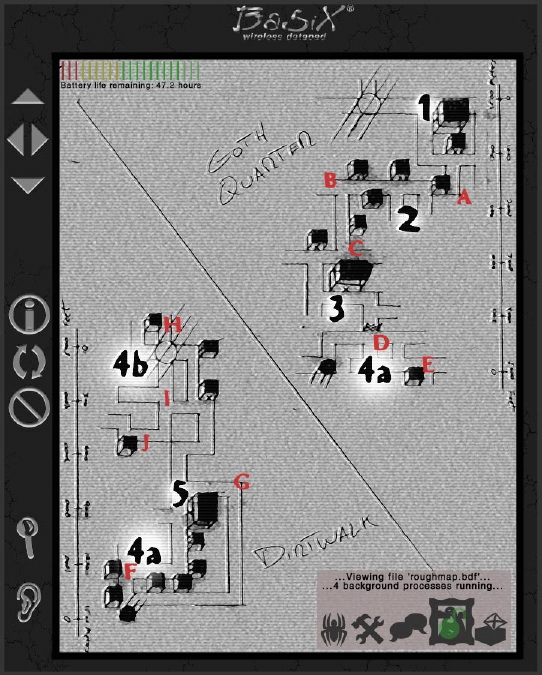
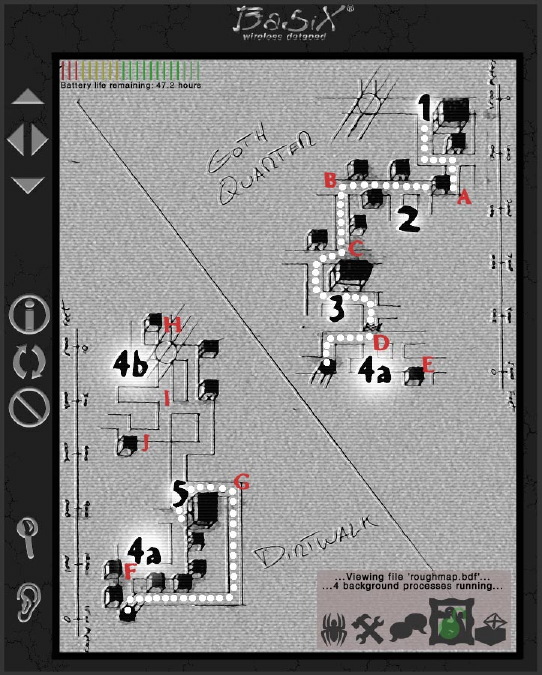

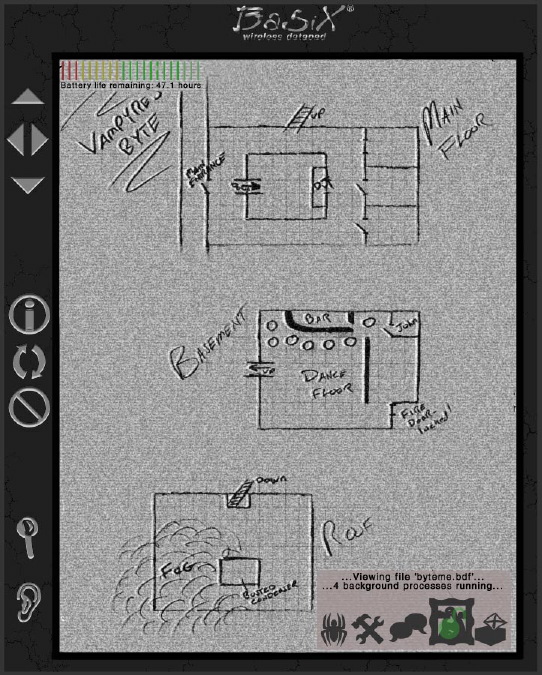
Scene 2. "Pursuit Pt. 1: Ins Unbetretene"
[ /\ ]S5. (Narrator)
"There is very little light here, as the crisscrossing catwalks above you and the thick mist combine to cut off most of the light trickling in through the dome. The air is eerily and unusually silent, but for the faintest of footfalls audible in the darkness. Even the shops here appear abandoned."
(The icons will have to cooperate and use all their skills to track the Morph, who is being remarkably good at pretending to elude them. If one of the icons suggests that it's too easy, it suddenly becomes hard. The pursuit will take them south out of the alley and into the Goth quarter of New Aurora.)
"After a short pursuit down twisty passageways, a cul-de-sac presents itself, a single door offering a clear answer to the question of where the Morph you're pursuing has gone."
(The following random encounters are designed to offer some potential happenings along the way. You may ignore any or all of these, as time allows and circumstance dictates. If you wish to leave it to chance, there's a 50% chance that any encounter will occur. Simply check each time the icons reach a lettered point on the map. In the event that you reach an intersection and wish to avoid a random encounter, then the icons will simply find clear traces that the Morph passed by, via a spot of blood or some other evidence that their skills are able to reveal to them. However, if you have time, you'll find that the random encounters add a lot to the overall story, and using all or most of them is thus advised.)
S6. (Random Encounter A)
"Gang signs and warnings adorn all of the walls in this building, which was apparently some sort of neighborhood grocer before the establishment was vandalized, looted and burned from the inside-out. Graffiti is even painted on the ceiling, floor and both steel doors, which were apparently all that survived this vicious attack."
The icons have evidently wandered straight into gang turf, and the Scythes are one of the toughest. What's worse, this building appears to be one of their crash rooms. It's filled with Goths and Shifters, all wearing gang colors.(Quick-thinking Goth, Morph or Shifter icons might be able to talk their way out of it, but other genotypes will probably have to fight. If there are any Vampires in the cast, then the fight will begin instantly. These Scythes do not like Vampires.)
(The gang members outnumber the icons by one, split equally between Goth and Shifter members (the edge going to Goth if there is an odd number.) In the event that there is only one icon, then there are three gangers here.)
Scythe Ganger (Goth)
Dressed in shining pleather, heavy boots and Scythe gang colors, this
heavily pierced individual's dark skin, hair and eyes betray his Goth
heritage.

Attributes:                              Skills:                     Target
----------------------------------       --------------------------  ------
As Goth template                         As Goth template
----------------------------------

Equipment:
----------------------------------
Switchblade (x3)
Gang jacket (10 durability)
----------------------------------       --------------------------  ------
---------------------------------------------------------------------------
Scythe Ganger (Shifter)
Tall, hirsute and heavily scarred, this muscular guy's dressed in shiny
pleather, heavy boots and Scythe gang colors.

Attributes:                              Skills:                     Target
----------------------------------       --------------------------  ------
As Shifter template                       As Shifter template
----------------------------------

Equipment:
----------------------------------
Gang jacket (10 durability)
----------------------------------       --------------------------  ------
---------------------------------------------------------------------------
(Should the icons somehow miraculously manage to avoid a battle to the death, one of the Goth gangers will offer them passage through the building, out through a door on the other side. If asked about the Morph, the Goth will deny everything. Pressing the issue will lead to an instant rumble.)
S1. (Random Encounter B)
"The road heads to the west, narrowly skirting a row of shops to the north. From atop balconies and catwalks above you, the zone's inhabitants go about their business, ignoring your presence. Stone facades have been built over the bare plasteel walls that the homes here are constructed of, and small towers, wooden slats, and even synthetic straw have all been added to make the area appear not unlike a medieval village."
Several blocks down, the icons will come to a broad intersection, at which point they will run into a group of human female teens.
Teen Girls
This group of female teenagers is incandescent in glitter, strobing jewelry
and synthscreen jackets tuned to their favorite videos. They're having a
good time, laughing and yelling and dancing. They look to be about 15 or
16 years of age -- considered adults in New Auroran society.

Attributes:                              Skills:                     Target
----------------------------------       --------------------------  ------
As human template                        As human template
----------------------------------

Equipment:
----------------------------------
Party clothes
----------------------------------       --------------------------  ------
---------------------------------------------------------------------------
The girls haven't seen the Morph, but they invite the icons along with them on their way to Cathedral.
(The girls flirt heavily with any even vaguely attractive member of the party, regardless of gender. If the icons refuse to join them, they head south anyway. If the icons insist on finding the Morph on their own, someone will spot some blood on the ground after a few minutes search. The trail leads south.)
S2. (Random Encounter C)
"The buildings here are a bizarre mixture of peaceful and extreme, medieval and technological. The neighborhood has taken on a peculiar look all its own, weaving between rows of buildings like a tongue down a throat. All around you, technology mingles with architecture ripped straight from history, creating a monster that only a monster could love. Gargoyles wearing mirrorshades sit atop plasteel homes, and neon statues dance to waltzes in midair. Directly to the south, standing tall over it all, is an immense cathedral, facing south."
(If icons are checking, traces of blood can be seen heading up to the side of the Cathedral, where a fire door is secured against entry. Any attempts to open the side door will fail utterly.)
As the icons head around the cathedral to enter it, a group of three drunk college-aged humans wander out of the darkness. They are obviously drunk and belligerent.
Drunk guys
Dressed in last month's latest "youth" fashions -- this time around it's
transparent, LED-laden bandoliers crossed over heavily painted chests,
hacked-off BDUs, hiking boots and neo-Fascist berets -- these guys swagger
drunkenly down the street.

Attributes:                              Skills:                     Target
----------------------------------       --------------------------  ------
As human template                        As human template, but -25 to all
----------------------------------       targets due to inebriated state

Equipment:
----------------------------------
Party clothes
----------------------------------       --------------------------  ------
---------------------------------------------------------------------------
(Attempts to walk away quietly or (from any female human icons) flirt will result in a reasonable chance of avoiding violence. Anything else will likely result in a fight -- especially if the guys notice that any of the icons are not human, which will happen if they hang around for longer than a minute or two.)
Upon leaving the drunks behind (or dispatching them), the icons will likely wander around to the front of the building.
"The main entrance to what looks like a cathedral rises up to the north, just across from the back entrance to the city cemetery and memorial park. The dark architecture continues to the southeast, with strange artifacts from out of history sharing space with the most recent technologies. The cathedral to the north is a good sign of this strange mixture, with neon and Gothic architecture combining as one."
(Map C offers a view of the interior of Cathedral.)
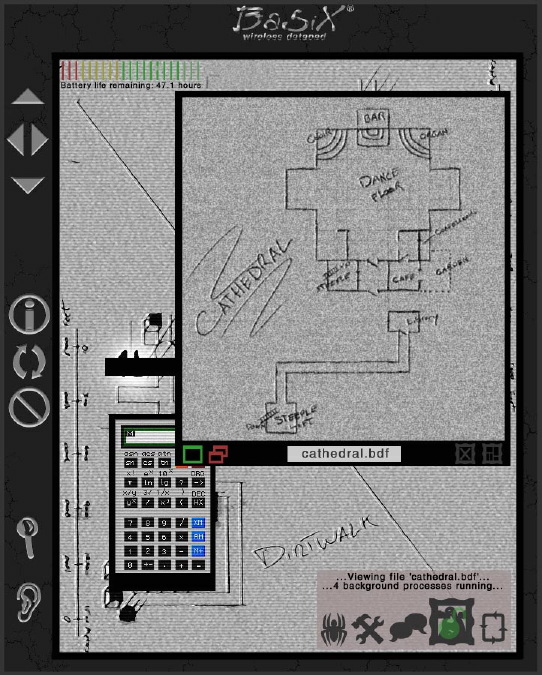
Scene 3. "Cathedral"
S3. (Narrator)
"The entranceway to these not-so-hallowed halls glows with the light of an orange neon logo set into the ceiling. Dance music can be heard rumbling to the north through open doors to the main Cathedral hall. A large monitor on the east wall displays footage of everyone in this room in reverse video, with a disorienting but interesting 5 second delay. Torches blaze in each of the corners against black walls, both casting additional light and touching the air with the musky scent of incense. A door marked "Off Limits" stands to the west. Between you and all of this is a large figure."
S3. (Bouncer)
The massive Cathedral dance club rises up imposingly before the icons. Standing between them and the interior is another imposing form -- that of a genetically engineered bouncer.
"Sorry. Nobody's gettin' in here without payin' the cover charge."
(If asked how much the cover charge is...)
"Well, that all depends. How much you got?"
(The bouncer will ask for 10 Credits per head, which is an exorbitant amount. If the icons hand it over, he will act surprised. If they argue, then the fun begins. Keep in mind that the bouncer is not in the mood for a bloody battle -- just a little argument to spice up an otherwise dull night.)
Cathedral Bouncer
A huge, muscular guy stuffed into a Victorian-style tuxedo. A bat-sized stun
prod dangles from a strap hung loosely across his shoulders, in easy reach.

Attributes:                              Skills:                     Target
----------------------------------       --------------------------  ------
PE:30     ME:25       Trauma:130         Rage(PS):20                   55
PS:35     MS:10                           \ \__Berserk(PP):15          55
PP:20     MP:10     Vitality:110           \__Ignorance(ME):10         55
PA:25     MA:10
PM:10     MM:10         Meta:85          Athletics(PE):15              45
----------------------------------
                                         Combat(PA):25                 50
Equipment:                                \ \__Unarmed(PS):15          75
----------------------------------         \__Melee(PA):25             75
Stunprod (x5)
Cathedral "Staff" T-shirt
Tuxedo pants, tuxedo jacket
Sneakers
----------------------------------       --------------------------  ------
---------------------------------------------------------------------------
(Getting past this surly bouncer could be a problem -- the easiest way will of course be to slip him a few dozen credits, or have female icons flirt with him. If the icons are friendly enough and don't act like idiots, he will eventually let them enter. If they persist in being dumb, or try to push past or attack him, he will press his lapel and trigger a silent alarm. 2 rounds later, more bouncers like him will appear, their total number equal to 1 more than the cast's strength. The same goes for any fights which might occur within the club -- 2 rounds after they begin, the bouncers will appear.)
(If the icons don't back down from a fight at the door, or if they enter the Cathedral and then begin a fight with anyone, they will be roughed up and ejected. The bouncers will not use their stunprods unless the icons pull weapons, in which case all bets are off.)
(If they pay, or otherwise charm their way inside...)
"Git! Just watch yoself! Don't cause no trouble and you won't get no stun prod up your ass, k?"
(If questioned about the Morph...)
"What? Ya think I got time to check the ass on every guy walks in here? Now that blonde chick in the bodypaint, her I can give you the zact coordinates for, yanno?"
He winks.
(If asked about Stitch, or Bio-Design...)
"I dun need none of that aug crap. Whatcha see is all natchrul."
He flexes.
(The bouncer has little to say on most topics, being exceedingly dull. He will grow tired of any lengthy conversations and begin raising the cover charge.)
(At some point the icons will inevitably get inside, one way or another. If they show any interest in the Off Limits door to the west, the bouncer will admonish them...)
"You best get away from there unless you got a special invitation."
(If asked about an invitation...)
"If you don't know, neither do I. Nuff said. Now git."
(The players will have to proceed north, onto the main dance floor.)
S4. (Narrator)
"The huge hall of the Cathedral opens in the shape of a cross, lit by an assortment of fires. The dizzyingly high vaulted ceiling echoes with a pounding bass dance beat combined with the ever-changing and haunting melody of a massive pipe organ to the north. The floor is crowded with dancers, although only one appears to be moving with any sort of talent, her smooth movements and silvery skin betraying her as a Morph."
(The Morph is obviously not the one the icons have encountered already, being quite obviously female. Nevertheless, they may choose to approach her...)
"The Morph is absorbed in her dancing -- slow pirouettes counterpointed by graceful arms tracing languid arcs above her head."
S4. (Dancer)
Morph Dancer
The cold grey of her skin is highlighted by luminescent blue bands of
shifting pigment, and her eyes shimmer like the basin of a turquoise
tropical bay. She seems almost ethereal, an effect heightened by the
translucent aqua folds of the billowing garment she wears.

Attributes:                              Skills:                     Target
----------------------------------       --------------------------  ------
As Morph template                        As Morph template
----------------------------------

Equipment:
----------------------------------
Silk dress
----------------------------------       --------------------------  ------
---------------------------------------------------------------------------
(If questioned, she will answer in a dazed voice. She may say something about seeing someone who looked like that over by the bar, but the savvier players will figure out that she's too spacey to be relied on.)
(If asked about the Morph assassin...)
"Hm? No ID. Maybe check the bar?"
She gestures northwards, towards the altar, the motion blending in with her smooth dancing.
(If asked about Bio-Design...)
"Dunno. I might have heard one of their songs? Are they a 20mm spinoff?"
(If shown the DataCube, or any of the information on it, she doesn't seem terribly interested. Observant icons will figure out that she's not even really looking at it.)
"That's nice. What kind of music do you have on there?"
(She will answer any other questions in a similar fashion, revealing nothing except the fact that she knows nothing.)
To the north of the dance floor lies what used to be the altar.
S5. (Narrator)
"Beneath the backlit eye of an iron-wrought stained-glass window, a massive marble altar spans a raised dais. The altar has been converted into a bar; various drinks are arranged across its top in a nearly ceremonial manner, to facilitate the intoxicatory rites."
S5. (Bartender)
Cathedral Bartender
She is dressed in a willowy black nightsuit, a waif of a girl who could be
twenty-five or fifteen just as easily. Cosmetic implants give her retinas an
onyx reflectivity that makes them seem infinitely deep and liquid. She seems
to see right into you.

Attributes:                              Skills:                     Target
----------------------------------       --------------------------  ------
As human template                        As human template
----------------------------------

Equipment:
----------------------------------
T-shirt, jeans, bar rag
----------------------------------       --------------------------  ------
---------------------------------------------------------------------------
The bartender is polite but uninterested, answering the icons' queries over her shoulder as she dexterously pours drinks and collects credits.
(If asked about the Morph...)
"Lots of customers. Can't really tell 'em apart."
(If they manage to show her the DataCube, or ask about Stitch or about "Bio-Design," she will startle momentarily but continue her work. It will take some persuasion (or money) to get her to admit anything, and that will not amount to much more than this...)
"He's somewheres down in the Causeway. Southern end of the Dirtwalk. Almost directly under here, come to think of it, if you could go straight down. But I wouldn't know nothin' about that."
(If pressed on any related matter, or asked more about the Dirtwalk...)
"No idea. Talk to Chris. In the cafe, over there."
She points towards the southeast.
(After this point, she will say nothing but "Talk to Chris." If the players get silly, she will not hesitate to call the bouncers.)
S6. (Narrator)
"This room was once the private chambers of the priests who ministered the cathedral. Now, it has been converted into a small coffee house, decorated in somber yet intimate tones. A small garden adjoins the room to the east, and comfortable chairs and tables have been placed throughout."
There's only one person behind the counter. It's obviously Chris.
S6. (Chris)
Chris (Cathedral Cafe waitress)
She's dressed in a trim black pantsuit, with a nametag that gives her name
as Chris. From her red crew-cut hair a single braided lock hangs over her
very tattooed neck. A polite smile somehow makes its way through gobs of
facepaint and burgundy lipstick.

Attributes:                              Skills:                     Target
----------------------------------       --------------------------  ------
As human template                        As human template
----------------------------------

Equipment:
----------------------------------
T-shirt, jeans, bar rag
----------------------------------       --------------------------  ------
---------------------------------------------------------------------------
(Despite what the bartender may have suggested, Chris will not be of much help at all, unless the icons want a cappuccino.)
(If asked about Stitch or Bio-Design...)
"Isn't that a game shop or something, down underground, one of those places that sells the simulations? I don't know."
She shrugs.
(If asked about an invitation, or the Steeple...)
"If you don't have an invitation, and I know you don't or you wouldn't be asking, then I can't help you."
(If asked about the Morph, she looks a bit nervous, but replies...)
"No one like that came in here on my shift."
[ /\ ](At this point, one of the patrons suddenly gets up and pushes past the icons, moving towards the exit. When he gets to the door, he is jostled and his cloak falls away... revealing the bloodied form of the Morph. The players can immediately pursue, but will have to make their way through the crowd and out onto the street.)
The Morph's lithe form slides across the darkened streets towards the southeast. By the time the icons are down the Cathedral stairs, the Morph has slid between the gates of the city Cemetery and vanished into the shadows.
Scene 4a. "Pursuit Pt. 2: Down Among the Dead Men"
S1. (Narrator)
"Like the mouth of hell, the twisted iron gates of the city cemetery rise up before you. A light fog drifts on an air current generated by some almost-hidden fog-making machines. The path splits just inside the gate, skating east, south and west between dark rows of gravestones and bushes."
Standing just inside the gates, happily drawing on gravestones with a stick of charcoal, is a mopey Goth.
S1. (Random Encounter D)
Mopey Goth poet
A tall, black-skinned man with a spiky shock of purple-streaked platinum
hair. Dressed from head-to-toe in rusty black and sporting the requisite
angst-rock-band-of-the-month t-shirt, he holds a dripping candle in one hand
and a stick of charcoal in another.

Attributes:                              Skills:                     Target
----------------------------------       --------------------------  ------
As Goth template                         As Goth template
----------------------------------

Equipment:
----------------------------------
Black clothing, candle, charcoal
----------------------------------       --------------------------  ------
---------------------------------------------------------------------------
(The Goth poet will not notice the icons' approach unless they're extremely noisy: he's too busy reciting quotes from Keats' "Ode on a Nightingale"..."
"Darkling I listen, and for many a time/I have been half in love with easeful Death/ Called him soft names in many a mused rhyme"
The Goth is scribbling embarrassingly bad poetry onto a wall -- something along the lines of "O desolate spirit, o sinuous doom, o absence of light in a very dark room." It's too dark to be sure if that's what it really says, though.
(If the icons draw attention to themselves, he will be half irritated by their intrusion, and half eager to show them how very despairing he is. He knows nothing about the Morph, has no idea who Stitch is, and -- if not quickly cut off -- will attempt to engage them in a discussion of Gothic literature.)
(If asked about the Morph or anyone passing by...)
"I believe I heard someone -- or something -- pass rather quickly to the southwest. You will forgive me, but I art too entranced with my art, as it were (raised eyebrow), to pay close attention to such incidental sounds."
(If followed, these directions will lead to Encounter E.)
(If asked about Stitch or Bio-Design...)
"I have no traffic with such things. Our feeble attempts to rewrite the Book of Man hath gotten me where I art. I will content myself with mine own poor pen, and not seek to snag that of the higher powers."
(If asked about anything else, he will wax poetic and act gothy. If for some reason he's attacked, he will flee into the shadows to the west and then vanish.)
S2. (Random Encounter E)
"A huge crypt lies to the south, next to a shiny brass plaque labeled "Marvell." Several smaller stones are also cast about the area. The flora is as elsewhere... it looks as if it's struggling to hang on to life, yet is still thick enough to block passage in most directions."
(Moaning sounds come from within the crypt, which is open. Assuming the icons investigate...)"Heavy and slightly awkward, the marble walls and columns of the Marvell family crypt give way to a delicate staircase. At the bottom of the staircase, two lovers embrace amidst a proliferation of candles, the scent of burning wax mingling with the stench of death. Golden candlelight shimmers off the marble walls and floor."
(The two lovers are not quite "in flagrante delicto", but they're getting there. If the icons barge in, or in any other way make their presence known, then the two will stop what they are doing and quickly scramble for clothing. Shirtless, the male will stand and move protectively in front of the girl while she struggles to put her clothing back together. They are half-indignant, half-embarassed, and will answer any questions in an irritable tone that suggests the icons have just ruined their evening. If you don't feel like doing both voices, the male will do all the talking.)
Two lovers
Stereotypically human, this young pair are of indeterminate racial origin,
but decidedly American in their haughty demeanor and mock modesty. They
seem to be in their late teens or early twenties, but with modern medical
technology being what it is today they could as easily be much older. Of
course, a much older couple probably wouldn't be making out in a tomb.

Attributes:                              Skills:                     Target
----------------------------------       --------------------------  ------
As human template                        As human template
----------------------------------

Equipment:
----------------------------------
Not much clothing
----------------------------------       --------------------------  ------
---------------------------------------------------------------------------
(If asked about the Morph...)
"Haven't heard anything. We were, um, too preoccupied to notice."
(If asked about Stitch, or Bio-Design, or shown the DataCube data...)
"No idea really. Sounds like something down in the Dirtwalk, for sure."
(If attacked, or asked threatening questions, the two will flee up a narrow staircase behind one of the many ornate statues in the crypt, making their way outside before the icons will be able to stop them since the hidden exit is directly behind them. If the icons return to the surface to try and catch them, they will see some dark forms scurrying towards the west.)
(Whether they pursue the couple, or make their way here on their own, or via deduction, the icons will eventually discover a large hole in the ground (the hard way) when one of them trips over it. Shining lights into the hole reveals that it goes down about 15 feet into a catacomb- like area, though it's impossible to see much more from up here. What can be seen are some faint traces of blood, and a few footprints in the damp soil below.)
(Should the icons drop down (and they have little choice), they will be unable to get back out.)
S2. (Narrator)
"Originally created to facilitate the building of the underground conveyer systems, the narrow, winding passageways now known as the Catacombs were recreated as such by a combination of history-hungry Goths, bored gangers and rich dilettantes with distinctly macabre tastes. Graffiti, elaborate murals, makeshift shrines and other such attempts at atmosphere obscure the packed dirt walls and floor."
There are several narrow passageways on all sides, but all signs seem to indicate that the Morph the icons are pursuing went down a large hole in the ground. A long, narrow steel ladder makes it obvious that this is not a naturally-formed hole in the ground, although the mud caked to the sides and the dripping water do a good job of concealing it from anyone not looking directly at it. The bottom cannot be seen.
(Should the icons attempt to wander around the catacombs, they will discover that each of the tunnels leads to a dead-end; if there are exits, they are not obvious. They will be able to make their way back to the hole in the ground, albeit with some difficulty and with the knowledge that the trail is growing colder by the minute.)
(Should they climb down the narrow duct...)
"Water runs down upon your face, bits of mud flaking off the walls and clinging to your brow as you clutch at the roots and broken pipes that jut from the walls. The tunnel above you twists and snakes out of view, leaving you crammed between rapidly constricting walls. Claustrophobia begins to take hold, the steady trickle of water mixed with sweat running down your face and neck. Dirt from above falls on your face, but there's no room to raise your hands. The walls press tighter and tighter until you have to suck in your stomach to proceed further down."
(There's no need to prolong agony for too long -- just get the point across that this is a slow, uncomfortable descent.)
After making their way down what is obviously more than several hundred feet, the ladder leaves off several feet above a heap of sodden trash and foul filth. There's only one way down -- dropping into the muck.
"This small pit might once have been an alleyway, but the area occupants have turned it into a rubbish heap. Everything unwanted gets tossed into the pile, including human fecal material, bits of electronic waste, rotten food, mud from new excavations and, apparently, bits of strangely human- looking organic material. A steady flow of water coming from several ruptured pipes and small tunnels helps keep the smell down."
[ /\ ]
Scene 4b. "Pursuit Pt. 2: Down & Dirty"
(There are two ways for the icons to get here -- the first is to take the path that leads through the cemetery and catacombs, and the second is to take the Caduceus. If icons have taken the more likely path (that being the pursuit through the cemetery), their first likely encounter will be Random Encounter F. If they've taken the Caduceus, their first likely encounter will be Random Encounter H, in Scene 4c.)
(In either case, there are two likely destinations (and one ultimate destination) that NPCs will direct the icons towards. If the icons are showing interest in the DataCube, or learning more about the information on it, they will be directed to the Road of Machines, and Encounter G. If they are wounded, or asking about Stitch or Bio-Design, they will be directed towards Scene 5.)
S3. (Random Encounter F)
The icons have made their way into the portion of the Dirtwalk known as the Causeway, a dark, crowded, cramped and wet area known for being the seedy underbelly of New Aurora. It's best known for the fact that it's almost always wet here, the 50-year-old water and sewage pipes that run overhead having sprung a few leaks over time. The air is misty, humid and barely breathable due to the stench of sweat and fungus.
(If the icons have taken the route down from the cemetery, which is most likely, they will have emerged from this cesspool. Upon heading to the north, the first sight they'll see aside from the masses of people is a small bar along the western edge of the tunnel. It's an obvious beacon of light amongst the dark mist, and no other landmarks present themselves.)
(Upon approaching the bar, a sign reading "La Sierra" becomes evident.)
"The rumble of the street walkers and noise make the floorboards resonate with the dirty life of the Causeway, making dry nut shells and plastic wrappers shiver. On a counter made of hundreds of cardboard sheets glued together into a stack elbow-high, they serve liquor here, in small shots since there ain't enough room on the shelves for beer. A large cactus sits in the corner choking on the night-life. To drive the point home, they've got pictures of desert scenes and a tattered poncho nailed to the wall."
The bar is surrounded by patrons, most of whom do a quick credit transfer in exchange for a shot or two of tequila and then vanish. The only individual who's in any mood to talk to filthy strangers is the bartender herself.
La Sierra Bartender
Her dark Mediterranean features obviously didn't come in a box: thick black
hair highlighted with oil and tied back in a gold-flecked elastic cord hangs
in a large tangle to the small of her back. Her golden-skinned shoulders are
bared above the white blouse tugged low over her arms, and gathered under
her bosom by a brass chain encircling her waist.

Attributes:                              Skills:                     Target
----------------------------------       --------------------------  ------
As human template                        As human template
----------------------------------

Equipment:
----------------------------------
Bar apron, jeans, t-shirt
Shot glass, bottle of tequila
----------------------------------       --------------------------  ------
---------------------------------------------------------------------------
(If the players buy a drink before asking questions, she will direct them to Bio-Design. If they don't, she'll hint for a little gratuity. If they are really broke and their sob story sounds sincere enough, she'll roll her eyes and tell them for free -- but they better remember that they owe her.)
(If they ask for any information...)
She smiles wearily, pushes a stray tendril of hair behind her ear.
"Would you like a drink first?"
(If players buy themselves or her a drink, proceed with the following responses.)
(If they ask for a good place to get tech intel...)
"You'll want to head down to the end of the Street of Machines. There's a deck doctor there who can help. Can't miss him."
(She will give directions to Encounter G.)
(If asked about the Morph...)
"Haven't seen him here, no. Any idea who he might be looking for?"
(If asked about Bio-Design, or shown the intel on the DataCube...)"Ah, Bio-Design."
She glances warily at the icons.
"You wouldn't be meaning Stitch any harm, would you? He's been very good to a lot of people down here."
(If they act fairly reassuringly, she will relent and give them directions to Scene 5.)"But if I hear that any of you gave him grief...just know that he and I have friends in neighborhoods you'd never think of."
(If they refuse or act haughty, without offering to recompense her for her troubles, she will smile graciously but refuse to proffer any more information. The same goes for if they stupidly indicate that they mean anyone (like Stitch or the Morph) harm.)"I'm sorry. I'd rather not say any more then."
(In the event that the bartender isn't talking, a drunk barfly will eagerly offer to help the icons if they buy him a drink. If they oblige, he will lead them to the opposite place they ask to go; if they ask to go to Stitch, he will take them to the Deck Doctor, and vice versa. Once there, he will vanish into the crowd.)
Drunk Barfly
This New Auroran is obviously a member of the lowest echelon of society, for
he's effectively been "condemned" to live and work underground. In a world
where you need money and status to earn money and status, he's been pushed
so far down that getting up again is a near impossibility.

Attributes:                              Skills:                     Target
----------------------------------       --------------------------  ------
As human template                        As human template
----------------------------------

Equipment:
----------------------------------
Dirty clothing, empty shot glass
----------------------------------       --------------------------  ------
---------------------------------------------------------------------------
S4. (Random Encounter G)
(Asking the honest guide, the La Sierra bartender, the pizza guy or a random kind-hearted NPC where to find a tech type who can have a look at the DataCube will result in the cast's getting taken to this deck doctor in the Road of Machines. As the icons approach...)
"Bodies press in on you from all sides as you get carried along in the flow of soft-junkies and techs. On one side, a projector shines out the latest 3D game, filling the air with gargoyles and and bikini-clad, gun-toting girls. Sometimes a disgruntled mutter emanates from the audience as less-savvy patrons walk through the beam, replacing the action with a blowup of their scalps. A large glass pane blocks the downpour overhead, pushing it to the sides. Along the Road, the dealers are illuminated with floodlights at sporadic intervals in the dark. One in particular stands out -- obviously the man to see in this area."
(The icons should obviously approach him in a friendly manner. Assuming so, they will see the following...)
"Even more crowded and cramped than the road itself, 'cause vendor kids are sticking chip-covered panels out into the traffic. To make things worse, the ceiling dips down and you have to shuffle just to move -- feels like you're part of one big stroke waiting to happen. Tiny things crunch underfoot, resistors and chips that no one found worthwhile enough to pick up. Amidst it all squats the deck doctor."
Deck Doctor
His hair is bright red and stands up on his head like a wiry brush. Pale
skin stretched tight over cheekbones that protrude in a gargoyle-like
fashion. Even as he looks up and interacts with you, he continues working --
you can barely discern the audible whir of nanoservos as his hands blur
across several keyboards laid out before him.

Attributes:                              Skills:                     Target
----------------------------------       --------------------------  ------
As Daemon template                       As Daemon template
----------------------------------

Equipment:
----------------------------------
Filthy clothing, random tools,
numerous keyboards and computers
----------------------------------       --------------------------  ------
---------------------------------------------------------------------------
(If asked about the DataCube...)
"I'll need to see it, and a 25 Credit transfer to my account, before I'm promising anything."
(Assuming they hand it over and transfer the creds, he will take it, insert it in a tiny box connected to one of his many computers, then study a monitor intently for a minute or two...)"This is some deep stuff. So you have your AI, and it's pretty well prog'ged, too. Bunch of stuff about this chick, Hiroki, some Asian girl, but I gather you knew about that already. But there's at least two more levels of cryp and a couple things that could be either data or progs. Way more intel than you prolly have time for."
(If asked about more information...)
"It'll take me at least a day and more than a jelly to grok this full."
(If the players don't understand his thick slang...)
"What're you, deaf? A jelly. One KY. A thousand Yen. Which I believe is about 2 thousand credits this week.
(If promised the money, he will chuckle...)
"Yeah, right. I seen your accounts. Like you have it."
(If asked about the Morph...)"Like I can see who walks by the stall, nemind some fekkin blueskin stealthin' by."
(If asked about Bio-Design or Stitch...)"Yah, office right down that way. But if you dun wanna pain flood, you do right to him."
The deck doctor gives some simple directions -- Stitch's place is right around the corner.
(Assuming they follow the directions, this will lead the icons to Scene 5.)
(If at any time the icons threaten him, he just chuckles. Seconds later, two MechMuscle pods descend into view.)
MechMuscle Pod
The black sphere bristles with minute gun-pieces and LED displays, and hums
like an angry insect. It is NOT something to mess around with.

Attributes:                              Skills:                     Target
----------------------------------       --------------------------  ------
PE:50     ME:50       Trauma:226         Combat(PA):50                 100
PS:50     MS:25
PP:50     MP:1      Vitality:201
PA:50     MA:25
PM:1      MM:1          Meta:128
----------------------------------

Equipment:
----------------------------------
Big mounted gun (x20)
----------------------------------       --------------------------  ------
---------------------------------------------------------------------------
[ /\ ]
Scene 4c. "Pursuit Pt. 2: Down & Out"
(Though unlikely, it is possible that the icons will opt not to pursue the Morph, and will toddle down to the Dirtwalk in the other way -- via the Caduceus. If and when this happens...)S4. (Random Encounter H)
"The Caduceus is an impressive double-helix escalator that winds its way up towards the high-class Upper City and burrows down into the Dirtwalk. Between the glimmering crystalline helices are eight symmetrical chrome elevator shafts, offering the same option."
Getting to the Dirtwalk is easy. Climb on an escalator or elevator and head down a few hundred feet.
"Short, wide tunnels lead off in all directions, where they quickly plunge into darkness. A hastily scrawled sign on the wall declares that you are now in the "Dirtwalk," the slang name given to this portion of the city's underground tunnel system which long ago replaced the initial moniker. Oddly enough, there are few people about at this moment, save for a lone pizza delivery person. just leaving a brightly-lit pizza place to the north."
Razzle's Pizza Delivery Boy
A nondescript teenager skates speedily along, a grimy red-and- white padded
bag teetering uncertainly on his upturned palm. The words "Razzle's Pizza
and Wings" are emblazoned on it; a pepperoni pizza rises, sun-like, behind
the phrase.

Attributes:                              Skills:                     Target
----------------------------------       --------------------------  ------
As human template                        As human template
----------------------------------

Equipment:
----------------------------------
Bright uniform, pepperoni pizza
----------------------------------       --------------------------  ------
---------------------------------------------------------------------------
(If the icons flag down the delivery boy, he'll skate to a stop and say hello. If any violence is threatened, he will skate nimbly away down the tunnel and vanish.)
(If the icons ask him where Stitch, Bio-Design or the Causeway are...)
"Hey, know what, I'm headed down that way now. Wanna tag along? I'll let you keep up for a small fee. Ahem."
The fee is 10 credits.
(If the icons refuse to pay and try to follow him anyway, he'll easily elude them after skating off to the south. If they pay, he'll gladly escort them through the Causeway and right to Scene 5.)
(Whether they allow the pizza delivery guy to skate away or not, the journey through the Dirtwalk will be an interesting one...)
"Though carved by human and nanite "hands," the walls of the concrete and steel tunnels through which you walk bear an uncanny resemblance to a medieval dungeon, complete with patches of moss and flickering, uneven light. Of course, the light comes from long fluorescent tubes, and the narrow apartment doors lining the corridor are definitely not medieval."
(If they try to go it alone, they will quickly realize they are lost. After a few minutes of this, a young boy will show up.)
S5. (Random Encounter I)
"Yo yo, you guys lost? Whatchou want, Billyboy can find, ask anyone, ask all. You afta somun?"
Dirtboy
This filthy youth is scrawny and undersized, but seems wily and intelligent,
even if he doesn't quite have mastery of the English language.

Attributes:                              Skills:                     Target
----------------------------------       --------------------------  ------
As human template                        As human template
----------------------------------

Equipment:
----------------------------------
Dirty clothing
----------------------------------       --------------------------  ------
---------------------------------------------------------------------------
(If asked for directions in any way...)"Yayaya, I knows where that is, 10 creds gets ya right there. You can even pay me once wese there, howzat? Esgo."
(He will lead them down several dark tunnels, until...)S5. (Narrator)
"Signs of fresh construction mar the walls in this dead-end hallway, though it is as yet impossible to determine which direction the tunnel will head once it is complete. Small niches mark future locations of possible homes and shops, and bare wires indicate the future location of the malfunctioning fluorescent monstrosities found all throughout the tunnels here."
(The boy will vanish into the shadows. From behind the icons will appear three figures. They look like they mean business, and attack immediately without speaking a word.)
Thieves
A wiry figure in a worn, shapeless black overcoat. Every other movement of
his arm reveals a faint glimmer from within one sleeve. The bags under his
eyes testify to many a sleepless night; the menacing glint in them, to
something far more dangerous.

Attributes:                              Skills:                     Target
----------------------------------       --------------------------  ------
As human template                        As human template
----------------------------------

Equipment:
----------------------------------
Dirty clothing
Switchblade (x3)
----------------------------------       --------------------------  ------
---------------------------------------------------------------------------
(Assuming they dispatch the thieves (who will fight only until it is apparent they are wounded, at which point they will do their best to flee. They will disappear almost immediately in the tunnels.)
(The players will likely wander some more, and have a 50/50 chance of finding Stitch on their own. If not, they will meet another young boy.)
S6. (Random Encounter J)
"Whatcha need? Whoya lookin for? Dave can track, Dave can trail, Dave can even detour for intel if that's what you dee-sire...."
Dirtboy
This filthy youth is scrawny and undersized, but seems wily and intelligent,
even if he doesn't quite have mastery of the English language.

Attributes:                              Skills:                     Target
----------------------------------       --------------------------  ------
As human template                        As human template
----------------------------------

Equipment:
----------------------------------
Dirty clothing
----------------------------------       --------------------------  ------
---------------------------------------------------------------------------
(If asked for directions in any way...)"Yah, Causeway, right. 10 Credits, in advance."
(If they pay, he will take them there immediately and then vanish. He can take icons to either Stitch (Scene 5) or the deck doctor (Scene 4b, encounter G). If they question his honesty...)"What, what, you don't like paying in advance? You don't pay up front, you gonna get screwed. You always pays in advance. But yo call. You don't want help you don't get help.)
[ /\ ]
(He will leave if not stopped and/or paid immediately.)
Scene 5. "Stitch's Bio-Design"
(Map S offers a view of the interior of Stitch's workplace.)
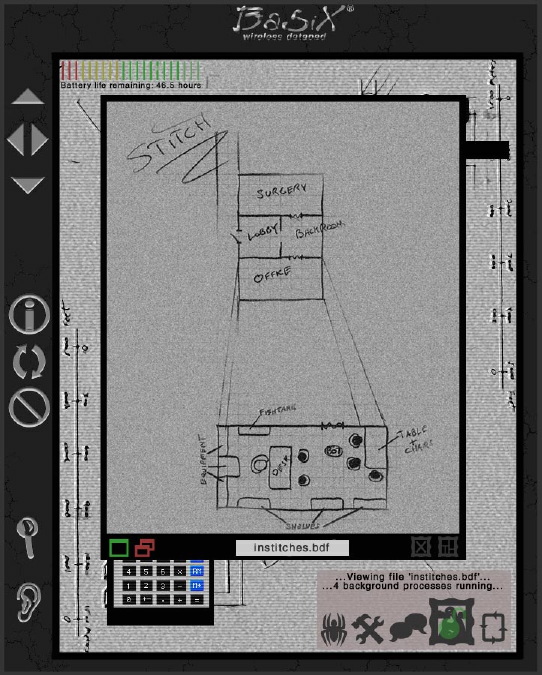
S1. (Narrator)
"You're surrounded by clusters of tanks, holding water that fluoresces. The ceiling's low, only it's mostly ducts and plumbing that runs from one big machine to another. Half the wall is either panels and gauges or wire. There's a small round table where there's room enough for a few people to stand, and two chairs. Walking around in here, it's like you dived into the ocean and the grafts and wetware floating up and down were a school of fish you were floating through."
(There aren't many choices here, nor is there anyone to help make the choice -- there's only one doorway to the east, through a curtain of wires and blinking sensors. If the icons seem hesitant, a loud crash followed by the sounds of cursing in Japanese will echo from the east.)
(If/when the players proceed to the east, they will see...)
"Here, more shelves hold bits and pieces in jars stored away and labeled. An expensive looking set of optical equipment -- microscope, monitors, digital camera -- is set out on a table with its own bank of illumination that contains all the colors of the spectrum. On the north and south sides of the room are thick plastic curtains."
(Should the players head north for any reason, including going there with Stitch if any of them are wounded and need medical attention...)
"At the center of the room sits a surgery table, bristling with restraining straps and metal devices with sharp hooks. Beside the table, banks of electronic devices disgorge a storm of wires and cords that link to different arms perched around the surgery stage. Against the wall is a large metal cylinder coupled to an equally large cooling unit."
(Should the players head south...)
"A clean metal desk as sterile as a surgeon's knife rests on six legs planted onto the cold stone floor. Thin black readouts are set into the desktop, displaying digital readouts of operations in progress. A simple metal chair, spartan and uncomfortable-looking, is set several paces from the desk. There are several studs on the surface of the desk and the chair; they look electrical and expensive. If you were sitting at the desk, the large array of jet-black equipment that looked like a horde of chromed spiders would be directly behind you. Directly in front of the door as you walk in is a large black pod, hovering in midair."
Stitch is in the room, fiddling with his optical gear. He will notice the players have entered, but will not immediately turn. He's not worried about them, since his large MechMuscle bot hovers in front of the door protectively, large guns displayed for all to see.
(If anyone is stupid enough to brandish a weapon or threaten Stitch, the pod will lurch menacingly towards them. Stitch will call it off and encourage the icons to put down their weapons. If for some reason they're being stupid, however, the pod will gleefully smoke them before they get anywhere near Stitch.)
|
S2. (Stitch)
(The icons will probably behave, however, in which case Stitch will
turn around and address them. If any are wounded, he will begin with
the following:)
"Oh my, you're making a mess. Come, let's get you cleaned up in the surgery. It's just across the hall. My assistant is out for the moment, but I'll do what I can."
Stitch bustles out of the room and urges all the icons across the hall, at which point he proceeds to tend to wounds.
(Stitch makes typical medical skill rolls, just like players do.)
|
(After the players are tended to, or if they're not hurt at all, Stitch
will invite everyone back into his office (assuming they're not already
there) and will sit down behind his desk.)
"Well well, I hardly expected the likes of you here. And yes, I know why you're here. You're looking for a girl. First of all, let me assure you that she's not in any danger. In fact, she's here of her own free will. But I will let her clear the matter up for herself."
Stitch reaches into his desk and pulls out a small silvery pod, which he places on the desk before him. The pod rises into the air. When it reaches eye level, a female voice speaks from behind the icons.
S3. (Hiroki Miu)
"I'm sorry about all the trouble. I really am."
The girl standing behind the icons looks oddly two-dimensional, and that's because she is. She's being projected from a pod, and she is nothing but a literal shadow on the wall. However, she is actually an Artificial Intelligence, and can converse with the icons for as long as they like.
Hiroki Miu is a young Japanese woman. While the porcelain sheen to her skin, the expensive simplicity of her blunt haircut and her well- tailored, conservatively-cut black suit evince material comfort, the regular features of her face seem unaugmented. Her voice is low and musical; her hands, slender, their fingertips coated with clear polish.
(Feel free to ad lib. The girl isn't exactly going to be forthcoming about the whys and wherefores of what's going on, but she can relay the following:)
Hiroki is, indeed, the "business partner" of Edward Lorton Smith. Their business, however, is not the traditional sort, but more of the... "underground" variety.
"I won't get into how this all got started. Suffice to say we ran into a bit of trouble, and I got knocked out of commission. Ed got knocked around pretty good too. So we came here to see Mr. Stitch. Or rather, Ed did. I was out of it at the time."
S2. (Stitch)
"Edward came in here looking like hell gone mad. His left eye was a disaster, worst I'd ever seen, and the rest of him wasn't in much better shape. Unfortunately for Mr. Smith, he didn't have enough funds in his account to pay for all the repairs I did. So he left something as collateral. A broken pod. Ms. Miu's pod."
"When he left, I took it upon myself to fix the broken pod. Because, well, that's what I do. Plus, if I was getting stiffed, I was going to at least see what the thing he'd left me could do. It took a few hours, but I managed to get it working. And Ms. Miu can take it from there."
S3. (Hiroki Miu)
"I told Mr. Stitch all about what was going on and how I got here, and he was really nice about everything. A few days went by, and there was still no sign of Ed. In the meantime, I got to liking Mr. Stitch a lot, and I decided I was going to stick around and help him out."
"Of course, that's when Ed came back."
Hiroki is interrupted as the Morph the icons have been pursuing stumbles into the room, covered in blood.
S4. (Morph Assassin)
"Ed came back."
The Morph stumbles to the floor and lies still.
(Unless the players have destroyed or discarded the DataCube, it will do the following; in the event that they DID get rid of the DataCube, the following will emanate from the Morph's body.)
There is a barely audible whistling noise, just barely within the realm of perception. It's emanating from the DataCube the icons have. Whether the icons reveal the cube at this time or not, the whistling increases in intensity, finally ending with a shrill pop.
All electronic devices in the entire office go dead. This includes Hiroki Miu's pod, which drops to the ground with a tinny bang as her shadow vanishes in mid-sentence, and the MechMuscle pod, which also collapses. Any electronic devices carried by icons also go dead.
(Any Daemons or Morphs in the party must roll against their PE -- failure results in their taking the result of the failed roll in Trauma damage, success results in no damage.)
S2. (Stitch)
"An EMP bomb! You brought an Electro Magnetic Pulse bomb into my laboratory! I'll, I'll, I'll..."
Stitch's stammering rant is cut off by a low chuckle from the other room. It's Ed, speaking from the darkness in the other room in a mocking voice.
S5. (Edward Lorton Smith)
"Your little bastard Morph almost got me, Stitch. Almost. But it appears as if I've gotten the last laugh. Those stupid icons walked right through your defenses and delivered the package. Now I'm here to reclaim my property, and you've got no floating warpod to save your ass now."
The sarariman was not killed, alas. As is revealed when he enters the room, he's not a mere human businessman, but a cyborg. He was only playing dead so the icons would do the dirty deed they just did. Now that the MechMuscle pod is out of the way, he's free to come take his partner's pod back.
Ed steps into the room, katana drawn. There will be no negotiation.
(Ed attacks whoever is closest to the door.)
|
(If the icons use tactics and gang up, they can take Ed down and/or offline quite easily, but if they are foolish he can quite easily cut several of them down very quickly.)
(It's quite possible, albeit unlikely, that all of the icons will be killed by Ed. In the event that even one of them goes down, Stitch will have triggered a call to the EMTs, who will arrive within 1d10 rounds, along with heavily-armed backup complete with more EMP bombs. One EMP will disable Ed instantly, which was why he couldn't deliver the bomb himself. In the event all the icons are taken out, skip the following and go to Hiroki Miu's part. Otherwise, proceed after Ed is taken out of action.)
S2. (Stitch)
"My God. My office is a disaster. This is a disaster. A disaster, I tell you. Oh God, Oh no..."
(If Ed is killed, Stitch will permanently disable him at this point by removing his head with a saw. If Ed is not killed, but only incapacitated in some fashion, the EMTs will arrive with muscled backup and will haul Ed out of sight.)
After bandaging wounds appropriately, getting severely wounded icons off to the hospital, etc., Stitch attempts to clear up the matter.
Ed did, indeed, come back, about a week ago. He demanded that Stitch return his pod immediately. Of course, Hiroki had no desire to return, so Stitch refused. His MechMuscle pod made sure that Ed couldn't harm anyone inside the office. Ed stormed off, promising vengeance.
Knowing he was probably up to no good, Stitch hired a Morph to trail him and take care of business. When the Morph saw the icons with Ed, Stitch told him to try to get them to follow him back to Stitch's place. Of course, he had no idea about the DataCube.
Evidently, Ed found an EMP bomb, disguised it as a DataCube, and got the icons to play patsy, carrying the bomb into the office where it would go off, disabling the MechMuscle pod, and allowing Ed to enter safely to retrieve his property.
(Now, of course, the pod is completely useless. Stitch offers it to the players free of charge. It's nothing but a toy now.)
|
If the icons take the pod, they will be contacted by Uganochev several hours later about it and asked to return it in exchange for 500 credits If they decline and opt to keep it, Uganochev will not press the matter; the icons will simply have a useless ball of fried electronics.Of course, any other personal electronics they were carrying are also fried beyond repair. Morphs and Daemons who suffered damage, however, will heal normally.
S3. (Hiroki Miu)
(Shortly after all of these events (in the hospital, if all the icons ended up there), Hiroki will show up out of the blue on one of the walls, a shiny new pod hovering in midair.)
"I just wanted to thank you for helping me, I guess. I mean, I don't know how you helped me, but Mr. Stitch down in the Causeway, he says you helped me out, and he said to thank you, and to tell you that each of you now has a thousand credits in your bank accounts."
Since she is an AI, Hiroki's memory is only as current as the most recent backup. When she was wiped out by the EMP, all the memory she'd been storing up was gone. When she was restored from backup, she only knew about what had happened up until about two weeks ago. Since Hiroki knows she is a "shadow on the wall", she can explain all this to the icons, but will have no knowledge of anything they've been through.
(The players do, indeed, each have 1000 credits in their accounts. Stitch is an honest man.)
"My last memory was of my partner Ed and I hanging out in the Vampyre's Byte bar. In the Goth Quarter, I think. I'm looking for him now. It's been weeks since I saw him. I'm wondering if he's OK."
(If Ed is dead, the icons will have the option to tell her this. If he was only incapacitated, the icons can also opt to tell her what has been going on, with Ed tricking them and attacking them and so on. In any case, she will always respond with the following:)
"No, I'm sure that's not right. Ed wouldn't go and do something like that. I'm sure you're wrong. I don't appreciate being lied to like that. Frankly I don't see what Stitch sees in you, or why he wanted me to thank you. You're all just a bunch of worthless icons. I'm going to find Ed. Good day."
Hiroki's shadow vanishes as the pod disappears around a corner and is gone from sight.
S6. (Narrator)
"Such is life in the dome. Live, die, fight, do your best to help, and in the end you're always on your own. Makes you wonder if there's really anything to this whole "hope" business after all. But tomorrow is another day, another dawn, another chance to make a difference."
[ /\ ]In addition to their credit rewards offered during the course of the act, each of the icons will receive 100 Improvement Points. Additional IPs can be awarded based on Role-playing merit, as discussed elsewhere in these rules. Influence for each player will go up 5 points (since they now have some powerful friends and enemies in the city of New Aurora). Plus, the players may have gained some decent equipment through the course of the action, depending on who they met and fought with. If any of these items (Ed's katana) would unbalance the party, these items can simply be taken away by the authorities.
Congratulations -- you've just finished the first Act of what could turn out to be a long, adventure-filled experience. Welcome to the city of New Aurora, and the world of Iconoclast!
5. More Sample Act Ideas
1. Down in the Park - Aridan Park
Even inside a domed city like New Aurora, there's always a chance to go for a nice picnic in the park. But maybe today's not the day. It seems that all the picnickers and hikers are getting stung by angry bees, and since the bees are genetically bred not to sting, there's obviously a real problem. Tracking the problem to its source, the icons will discover that something's abuzz at the apiary, and it all has to do with a hidden stash of jewelry, a psychotic robotic reaper, and a gang who's come up with an insidious plot to grab gobs of loot using insects to do their dirty work. And the worst part: who's going to believe you when you try to explain all this to the cops?
2. Baby Got an Atom Bomb - Slurry Plaza
Where does it snow inside a sealed dome? Only one place -- Slurry Plaza, an ice-skating rink and veritable winter wonderland hovering hundreds of feet above the ground in the southwestern part of the Skywalk. Just the place for a terrorist to threaten the lives of hundreds of people... and of course, the icons just happen to be there when it goes down. They know there's a bomb, and they know where it is... but how do you disarm a bomb that's in a basket with a little baby? Move the baby? Not so easy... not when the bomb will go off if the baby is moved. Leave the baby alone? Fine... but if the baby wakes up and starts crying, the bomb will go off all the same.
3. Temple of Love - Cathedral
The nightclub known as Cathedral was once the real thing, a place where God- fearing people gathered to worship, baptize and marry. In a throwback to the old days, the club's arranged a huge rave-style party, the culmination of which will be the marriage of a cute young Goth girl and her Shifter fiance. Of course, nobody expected the unofficial patriarch of the Goths -- the Gothfather -- to show up... nor did they expect the current alpha male of the New Auroran Shifter tribe to be in the wings either. And of course, wouldn't you know it -- now the Goth girl's gone missing, and nobody's getting out until she's found. Nobody. Is she playing hide and seek? Does she have cold feet? Or is someone trying to stop this marriage... and why? Will this lead to an all-out gang war the likes of which has never been seen before, or will the icons manage to smooth things out. Can love save the day?
4. It Can't Rain All The Time - The Causeway
Down in the DirtWalk, a neighborhood known as the Causeway lives directly underneath a major water line, its constant leaking causing a more or less steady drizzle to saturate the area. Needless to say, the people who live here aren't very well-off or happy, so when something shakes up their little microcosm, the gangers who live down here really get bent. Like when the guy they killed the other night suddenly reappears, taking on the gangers one at a time and leaving their remains hanging from the overhead pipes. Turns out their easy target wasn't human after all, and his Goth healing abilities brought him back from the brink. Who's right? Who's wrong? Who will the icons help? Who's paying the most?
5. Bloodletting - The Skywalk
The icons are wandering or lounging about when one of them feels something drop on his or her head. Wiping it away, they discover that it is blood. A quick glance upward reveals a fallen figure, several hundred feet above their heads in the Skywalk, the network of catwalks and bridges that crisscrosses the entire downtown area. Not only must they negotiate the oft confusing twists and turns of the Skywalk, but once they reach the area where she was, they discover she's gone. All that remains is a trail of blood... and it's heading not down, but up. Up towards the Upper City, the domain of the rich and powerful, the sort of place called "Heaven" by some and far worse names by others. And the sort of place where the icons will not be welcomed with open arms, particularly when they might be on the trail of a killer who's wealthy and powerful enough to get away with murder.
[ /\ ]
Appendix
Guide to Charts
Section     Chart Name
-------     -------------------------
  1.5       Genotype Age Limits
            Height/Weight (English)
            Height/Weight (Metric)

  2.2       Generating a Target
            Common Modifiers

  2.4       Attack roll/Multipliers
            Armor/Multipliers

  3.4       Influence Levels
Conversions and Measurements
1 hour = 60 minutes = 600 rounds
1 round = 1/10 minute = 1/600 hour

3 feet = 1 yard = .9 meters
1000 meters = 1 kilometer = 1.6 miles
5280 feet = 1 mile
Random Number Sheet
57 34 52 04 36 61 40 86 45 10 44 93 43 20 16 49 98 76 94 51 85 74 18 73 25
27 80 06 79 84 56 63 07 39 91 38 33 75 96 65 92 69 00 09 46 05 23 82 50 17
31 77 28 01 78 89 08 60 66 88 12 71 15 59 14 35 54 37 26 47 72 68 03 42 02
62 53 83 32 55 87 90 64 81 30 48 41 97 58 99 67 24 29 22 95 70 19 21 11 13

05 28 79 53 81 64 06 92 36 84 10 68 89 43 67 21 69 42 23 00 39 24 25 38 48
27 78 77 08 82 59 65 61 66 32 11 91 44 31 33 90 95 30 51 74 99 73 35 49 97
03 52 86 54 63 07 96 88 18 57 04 13 85 71 94 26 17 75 46 76 50 19 22 12 14
60 01 56 80 37 83 02 09 58 15 62 87 41 93 20 45 40 16 98 29 55 70 72 47 34

06 54 85 82 88 65 12 89 96 92 95 44 15 45 90 46 75 97 43 50 74 59 18 99 16
01 53 83 03 42 87 37 35 61 67 36 21 70 68 62 98 41 22 25 64 30 49 86 09 48
78 05 80 55 29 10 56 77 57 33 38 69 63 40 13 17 72 27 76 47 51 04 23 32 02
52 79 81 08 60 28 84 58 31 07 11 93 39 66 91 94 71 73 14 34 19 00 26 24 20

47 26 35 33 46 56 78 81 44 59 51 62 49 54 09 28 18 04 63 91 38 31 36 07 73
20 70 58 02 21 10 17 68 48 94 57 71 00 39 88 30 19 16 01 41 87 65 64 43 74
61 95 67 97 89 34 93 72 14 25 83 75 99 52 08 84 60 98 40 12 55 85 77 13 79
96 06 76 22 86 45 24 42 66 92 90 80 03 53 37 11 29 32 15 05 82 69 50 23 27

08 06 35 58 70 59 98 22 42 96 34 89 66 03 67 74 19 60 62 49 16 83 36 57 37
26 45 90 95 99 50 07 25 94 18 09 32 38 52 40 13 78 54 69 86 63 73 01 43 87
64 23 92 02 20 17 39 82 14 30 51 11 79 33 41 77 65 12 56 00 48 28 81 31 24
68 53 15 84 55 05 21 71 93 85 10 29 76 61 72 97 75 44 80 47 91 46 04 27 88

18 77 39 20 23 13 46 73 31 02 32 64 36 58 27 38 06 01 44 57 15 14 51 71 09
87 96 92 49 10 41 55 19 35 60 79 24 16 59 65 28 05 43 45 52 81 22 85 70 91
95 99 40 82 50 94 78 26 34 11 72 54 62 25 48 04 30 08 42 07 63 66 90 76 86
00 98 83 88 93 75 12 21 33 61 56 97 03 47 74 29 53 37 17 67 69 68 80 84 89

70 91 22 98 29 93 20 73 88 06 03 96 37 89 87 68 00 02 92 77 61 52 53 67 11
59 43 17 80 36 62 27 51 13 75 31 28 81 55 48 40 18 16 95 32 39 76 66 47 05
60 65 79 84 35 15 09 26 14 07 10 54 74 83 57 49 08 30 41 85 42 99 44 90 72
34 46 01 71 38 69 24 33 12 97 25 86 45 78 23 21 19 50 63 04 58 64 56 94 82

62 86 82 29 37 14 57 69 11 33 66 16 07 30 26 98 40 73 49 51 47 27 43 20 83
44 24 42 53 12 76 91 54 71 99 25 19 08 23 01 87 84 96 77 03 89 39 35 06 72
78 79 48 85 52 74 05 75 60 63 93 56 21 36 31 61 67 41 28 00 58 45 90 97 46
92 15 09 34 04 38 94 95 10 18 17 50 59 65 64 68 13 88 32 22 02 55 80 81 70

43 84 37 21 17 81 99 26 01 89 05 96 74 77 66 95 87 38 56 20 35 57 49 75 83
52 82 31 34 47 46 60 80 69 50 11 22 86 30 23 19 29 98 02 79 51 58 70 08 00
94 76 91 45 09 25 48 40 41 78 33 12 68 14 18 61 44 85 16 15 71 88 28 07 36
67 13 62 04 55 32 73 03 64 42 53 97 63 92 27 93 24 72 65 10 59 39 54 90 06

03 80 48 77 15 83 39 81 01 82 36 56 07 69 47 09 66 75 34 21 63 78 87 71 62
17 84 35 53 58 88 98 08 02 16 05 00 90 91 73 95 14 49 51 70 61 27 30 43 67
79 52 32 37 54 59 31 72 89 60 85 46 97 45 38 92 24 44 94 04 64 19 06 12 22
86 29 57 25 26 68 18 99 11 40 33 41 20 10 42 23 74 50 76 13 55 93 96 65 28
To use this sheet instead of dice, grab a pen or pencil, poke randomly at the page (close your eyes or look away to be sure it's random) and cross out whatever number you poked (or whichever you're closest to). Whenever you need to roll a die for any reason, use the number that's next in line to the right. For a forced, non-repetitive random distribution, move back up to the beginning of the block when you reach the end (since each block of four lines contains every number from 1 to 100, once.) For a more truly random distribution, simply move down the page until you reach the bottom, then pick up again at the top. To print out different random number sheets when this one is used up, visit http://www.iconoclast.org/tools.
[ /\ ]
Afterward
Thanks for being a part of the first release of the Iconoclast RPG. Your comments and questions will help turn this alpha-test version into a much better product, so please, send us feedback to aeon@iconoclast.org.
Additional information and materials will always be available online at www.iconoclast.org. Or, visit our MUD at telnet://iconoclast.org:7777.
[ /\ ]